How the Economy of Live Sport Has Evolved – From Community Grounds to Center Stage

The lights dim. 70,000 people hold their breath! A stadium roars! A bowler runs in! A dancer takes position. A CEO watches from the VIP box…
For 3 seconds, sport and entertainment become the same thing. That’s not an accident. It’s by design. It’s operations. It’s the economy of “Live”.
Sports isn’t just a sport anymore. IT’S THE ECONOMY OF LIVE.
When I started in live events 40+ years ago, “sports event” meant a ground, a whistle, and maybe a local sponsor’s banner. Today, a single IPL match is a $500 million ecosystem. A Formula 1 weekend fills hotels, airlines, and restaurants 6 months in advance. The Paris Olympics didn’t just sell tickets — it sold city branding for a decade.
Why? Because sports are rapidly moving from “competition” to “content”.
Every match is now a 3 to 4-hour live show. With pre-show, halftime, post-show engagement in different forms. With celebrity owners, DJ drops, cheer squads, drone shows, and AR graphics. Core sport is only 30 percent of the experience. The other 70 percent is what I call “immersed engagement through entertainment”. This shift is why sports is now one of the fastest-growing contributors to the experience economy.
• It creates jobs – from groundsmen to data analysts.
• It drives tourism – fans travel for “away games” like they do for pilgrimages.
• It builds cities – stadiums become anchors for real estate and infrastructure.
Above all, it sells eye balls — attention: the real currency in 2026.
Grassroots tournaments taught me this early in life. A local school kabaddi match with 200 people still needs crowd control, sound, and a story. Scale it up, and the math changes — but the muscle memory remains the same.
Immersive Engagement & Entertainment – Where SPORT + SHOW Become ONE
The line between sport and entertainment has dissolved. And that’s a good thing.
Think about it:
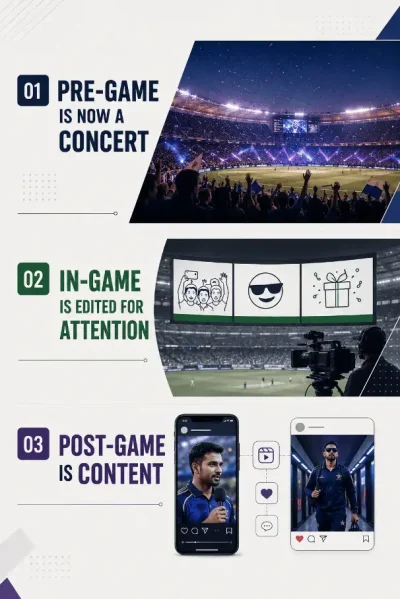
1. Pre-game is now a Concert. IPL openings have Shah Rukh Khan, Arijit Singh, and laser shows before the toss.
2. In-game is edited for Attention. Jumbo trons show fan cams, memes, sponsor activations. 8 seconds of action, 2 seconds of entertainment.
3. Post-game is Content. Player interviews become Instagram reels. Tunnel walks become fashion moments.
This is immersive engaging and entertainment. The audience isn’t just watching the sport. They’re living inside a story. I learned this while curating weddings too. A couple doesn’t just want a ceremony. They want a 3-day film they’ll re-watch for life. Sports fans want the same – a lasting memory, not just a match.
But the challenge is – Sport has rules. Entertainment has spontaneity. Marrying them needs intricate planning. You can’t script a six, but you can surely script what happens 10 seconds after it.
The Invisible Engine – Intricate Planning for an Experiential Impact
Everyone sees the glory: the trophy lift, the slow-mo replay, the brand on the chest. Few see the grassroots of it – the 4 AM ops calls, the briefings, contingency plans, the stakeholder maps. In my world of live events, I live by three rules. And they apply 10x in sports –
RULE 1 – Design/Curate for two audiences, not just one.
• The audience in the stadium wants energy, chants, and quick food lines.
• The audience on TV/OTT wants camera angles, replays, and sponsor visibility.
The stakeholders — boards, sponsors, broadcasters, athletes — want ROI, brand safety, and zero chaos.
Experiential planning means mapping the journey for all above. Where does a sponsor’s logo get max eyeballs? Where does a fan get their water fastest? Where does an athlete get silence before performance? One plan, three experiences.
RULE 2 – Operations is your brand.
A perfect match with bad entry gates, no adequate washrooms, drinking water facility = bad memory. A last-ball thriller with no signal for UPI payments = lost revenue.
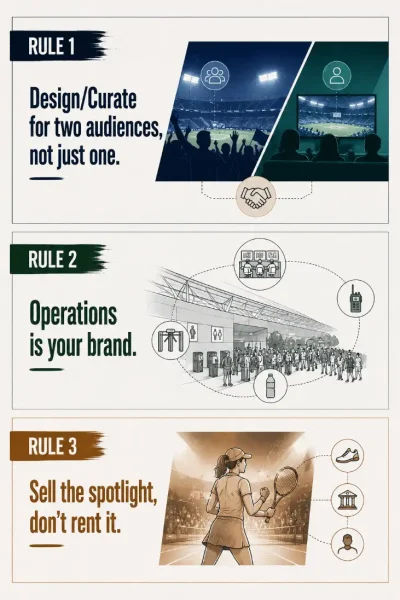
RULE 3 – Sell the spotlight, don’t rent it.
Sponsors today don’t want banners. They want stories.
For example, at a district-level tennis tournament, we didn’t sell the court signage. We sell “the story of the first girl from this district to win a national title”. That story will attract a sports brand, a bank, and a local MLA. Same story applies at the IPL level — channels and franchises are selling “fandom + culture”, not just airtime.
This is the real economy of sport – turning 22 players on a field into a 365-day content and commerce engine.
Grassroots to Glory – India’s Sports Future
India is at an inflection point. We’re not just cricket anymore. We’re trying to host Formula 1 again, bidding for Olympics, and building leagues for football, hockey, table tennis, badminton, kabaddi, pickleball.
But glory without grassroots is a bubble. And grassroots without professional operations is a hobby.
The gap we must bridge –
1. Treat every local tournament like an IP. Document it. Brand it. Make it repeatable. That’s how IPL started too.
2. Train operations talent like we train athletes. The person managing crowd flow needs as much respect as the captain.
3. Measure ROI beyond trophies. What did the event do for local jobs, tourism, and youth aspiration? That’s the real receipt.
Take for instance – VAIBHAV SOORYAVANSHI: The new kid on the block, the current apple of the eye. If grassroots is the soil, then talent like Vaibhav Sooryavanshi is the proof that the soil is alive.
At 14, he didn’t just play cricket. He reminded us what “apple of the eye” means — that rare, raw, dedicated talent you must spot early, protect fiercely, and nurture patiently.
Vaibhav isn’t a headline. He’s a responsibility. His story tells every district-level coach, every parent in a small town, every event organizer at a local tournament – the next glory is already playing on your ground. But talent alone isn’t enough.
The way ahead is clear –
1. Spot early – Build scouting and event systems that find the Vaibhavs of the world, before they quit due to lack of opportunity.
2. Nurture with structure – Talent needs coaches, yes. But it also needs medical support, mental conditioning, financial literacy, and brand management. That’s where professional event ecosystems come in.
3. Protect from noise – Glory brings glare. Operations must shield young talent from burnout, exploitation, and distraction so the dedication stays pure.
Bringing to the fore, nurturing, and backing talent like Vaibhav must be the way ahead. Because when we invest in one Vaibhav, we create a pathway for 10,000 kids watching from the boundary line to believe – “That could be me.”
This belief is the real ROI of grassroots. And this is how India moves from occasional brilliance to consistent world dominance.
Conclusion
My 45 years managing all scales of events, weddings, concerts, and corporate shows taught me one truth – the show you remember is built in rooms nobody sees. And Sports is no different.
Grassroots to Glory – isn’t a ladder. It’s a loop. Glory creates aspiration. Aspiration fills the grassroots. Grassroots, done right, creates the next glory. As India builds its sporting future, we need more than players and stadiums. We need curators, operators, storytellers, and sponsors who understand that sport is now the biggest stage for live experiences.
Because when the final whistle blows, people don’t just remember who won. They remember how it felt to be there. And that feeling? That’s the economy we’re building. One match, one moment, one experience at a time.
Glory is what the crowd sees. Grassroots + Operations is what makes it possible.