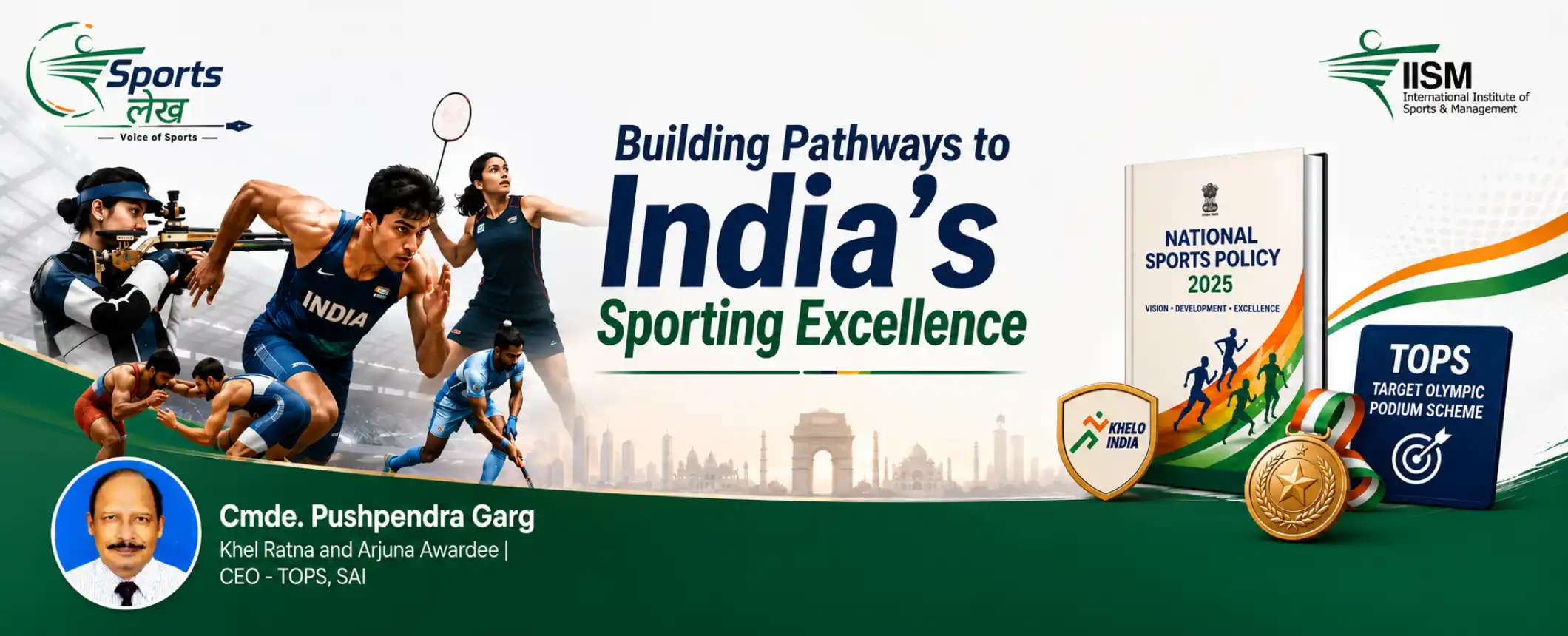
Building Pathways to Sporting Excellence: India’s Sports Governance Imperative

Sports excellence is more than winning medals or breaking records — it is an athletes relentless pursuit to reach his or her highest potential. It is a blend of physical skill, mental resilience, discipline, and ethical conduct into a standard that inspires younger athletes as well as fans. In a world where competition is fierce and margins of victory are razor-thin, excellence in sports becomes a testament to human dedication and the will to improve.
The 21st century views sport as a global phenomenon, one that influences positively billions of people’s social and economic conditions worldwide. The akharas and boxing rings of Sonipat and Rewari in Haryana or the multitude shooting ranges in Baghpat in Uttar Pradesh or the multiple Badminton academies in Hyderabad are today cradles for producing champions. Sports can be seen today as platform for personality development, cultural and social exchange and a plethora of economic upliftment and opportunities.
With the advent of globalization of sports, the need to value it as a way of life becomes even more challenging and perplexing among nation-states, local institutions, sports organizations, and other sports stakeholders and actors, particularly in the field of governance. Sports are associated with national pride. Nation-states have, since the turn of the century, equated growth in sports excellence with social, economic, and political growth and development, akin to an arms race in sports.
The building of pathways towards excellence has brought together various stakeholders, mostly led by the respective national governments who see international sporting success as an inspiration and a national ‘feel good’ factor and for its capacity to deliver economic benefits through the hosting of major events. However, there is a need for proper structures to ensure the right governance which contributes to building of sporting success of nations.
This article, “Building Pathways to Excellence: The Governance Imperative Behind India’s Sporting Success”, will address some issues on how the government initiatives to provide governance structures can connect schools, academies, universities, armed forces, state associations and national federations into a cohesive athlete development system. The article will also highlight the recent reforms which can bring accountability mechanisms and collaborative frameworks to transform India into a consistently successful sporting nation.
Introduction
This participation of multiple actors and stakeholders including the government, not-for-profit organizations, business and industry leaders, academia, and individuals in the formulation, legitimization, and implementation of sports programs, policies, and projects for sports excellence and development brings in the astute paradigm of sports governance to the fore, which binds them together in the pursuit of delivering sporting excellence.
Ian O ‘Boyle and Trish Bradbury in their compilation of International Case Studies in Sports Governance say, “As sports organizations are required to become more professional and adopt a more transparent and accountable approach to their operations, it has become important for all students, researchers, and professionals working in sports to understand what governance is and how it should be achieved.” (O’Boyle & Bradbury, 2013).
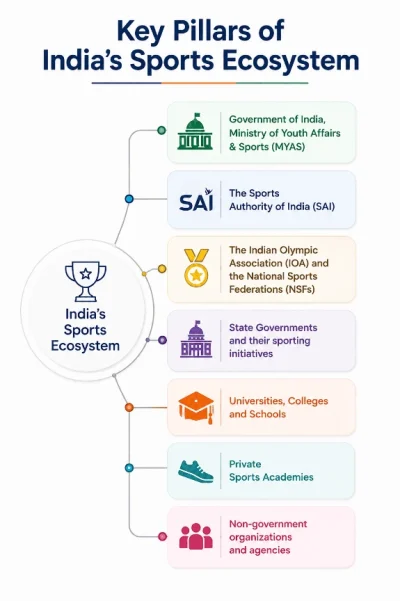
As a consequence of the increased interest on elite sport success, the leading question as to what are the factors determining sports success has generated a lot of research. The SPLISS model (De Bosscher et al., 2008) offers a broad framework of elite performance with nine pillars, including financial provision, talent identification, coaching, and sports science. Further achieving sporting success includes a plethora of stakeholders. In India some of them can be listed as follows:
-
Government of India, Ministry of Youth Affairs & Sports (MYAS)
-
The Sports Authority of India (SAI)
-
The Indian Olympic Association (IOA) and the National Sports Federations (NSFs)
-
State Governments and their sporting initiatives
-
Universities, Colleges and Schools
-
Private Sports Academies
Non-government organizations and agencies
The Role of Government
The MYAS leads India’s sports governance paradigm and functions as the nodal authority for policy formulation, funding, and overall coordination of sports development in India. National Sports Policies on governance are drafted and issued by the MYAS. The MYAS also exercises some regulatory influence over National Sports Federations through recognition norms and compliance requirements, thereby shaping governance standards within the sports ecosystem.
Dr. Vivek Sangwan & Ms Minakshi in their Analysis Of Policy Implementation And Outcomes conclude that, “Sports governance in India represents a critical dimension of public policy with significant implications for athletic performance, institutional accountability, and social inclusion.”
The National Sports Policy 2025
The resurgence of sports governance in India is paving the way for greater participation and higher performance. In July 2025, India came out with the National Sports Policy – Khelo Bharat Niti, which aimed at transforming India into a global sporting powerhouse, through five strategic pillars. Starting with early talent identification, the policy aligned with the National education Policy by embedding physical literacy and sports directly into school curricula. It also mandated specialized training and certification for Physical Education (PE) instructors.
The policy envisioned sports as a people’s movement and laid out a path for sports to unite and uplift communities thus harnessing sports for social change. It also laid out that sports would be a catalyst for economic growth with job creation opportunities, public-private partnerships and CSR initiatives by Corporate India thus fuelling the growth and turning sports as a vibrant industry.
Government Initiatives: Khelo India
In 2017, the MYAS launched Khelo India – National Programme for Development of Sports, to revive sports and bring inclusivity by identifying young talent and nurturing them through the programme to transform them into elite athletes.
The Khelo India Scheme includes:
– Playfield development
– Community coaching development
– Promotion of community sports
– Establishment of a strong sports competition structure at both school and university level as also for rural/indigenous sports
– Sports for persons with disability and women
– Filling up of critical gaps in sports infrastructure
– Creation of hubs of sports excellence
– Talent identification and development
– Support to sports academies
– Implementation of a national physical fitness drive for school children
– Sports for peace and development
The two annual Khelo India Games at the University and the School level directly provided the College and school athletes a national platform to perform and get identified for future glory. By making the State governments the host for these Games, the States infrastructure and administrative capacity was also enhanced with each edition of these games.
Once identified the athletes were provided world class facilities at SAI’s National Centres of Excellence (NCOE) or at private/government institutes/academies of their choice like Army Sports Institute or the Inspire Institute of Sports run by JSW Sports, Reliance Academies run by Reliance or the Centre of Badminton Excellence run by Pullela Gopichand and Prakash Padukone to name a few. Experienced coaches and world class sports science facilities are being provided at these centres and the result of this can be seen both on track and field as well as on the courts. The Khelo India Programme provides the overall MYAS instituted governance structure for these athletes and is monitored regularly by government.
Strengthening India’s Sports Federations
The MYAS and SAI continually work with the NSFs through the Assistance to NSF Scheme (ANSF Scheme) of the MYAS. Funding is provided by the government to the NSFs as agreed during the Annual Competition and Training Calendar (ACTC) meetings. The scheme document provides the governance structure and guidelines to the NSFs regarding the assistance provided.
The guidelines for the scheme have been revised periodically, the latest being in May 2025 wherein NSFs have been mandated to earmark 20 percent of assistance provided for grassroots development and 10 percent towards development of coaches and technical staff. The remunerations for Indian coaches and support staff were also enhanced substantially to ensure a push for more Indian coaches. Government initiatives have strengthened the administrative capacity of the NSFs towards achieving professionalisation. Through this support many NSFs have appointed CEOs and young sports professionals who are thus bringing the desired efficiencies in their day to day functioning and administration.
In the last few years direct funding for athletes through the Target Olympic Podium Scheme (TOPS) has provided the most necessary requirements to the elite athletes both at the podium as well as development levels. Professional staff including coaches, physiotherapists, mental conditioning professionals and specialised training in elite international training venues such as Colorado Springs and Chula Vista in the USA, Saarbrucken in Germany, to name a few have been made available to the athletes. The programme has now been extended to the elite coaches also for further upskilling them. A shout out also goes to various public sector enterprises including NTPC, REC Limited, Indian Oil, ONGC, etc. who have come forward and pitched their CSR funding for strengthening the TOPS as well as for the development of specific Olympic medal sports.
National Sports Governance Act 2025
To further provide a unified, transparent, and accountable framework for sports administration in India, replacing the earlier National Sports Development Code of India (2011), which had gaps in governance and accountability, the government enacted through the Parliament the National Sports Governance Act, 2025. This is a landmark law designed to professionalize sports governance, ensure athlete welfare, and align national sports bodies with international standards. The Act’s alignment with the Olympic and Paralympic Charter addresses one of the most complex challenges in sports governance – balancing national regulatory requirements with international sporting autonomy.
The act provides a legislative framework with enforceable rules, reducing reliance on ad hoc guidelines and court orders. The mandated codes of ethics and grievance mechanisms enhance transparency and accountability. Further, the National Sports Governance Board created through this act represents the central regulatory mechanism through which the government would exercise its oversight function without directly interfering in day-to-day sporting activities. The National Sports Tribunal would ensure a conflict resolution mechanism and reduction of a plethora of court cases on Sports in various courts of India.
The inclusion of athlete representation in executive committees and the Safe Sport Policy are progressive steps in conformity with happenings in all major sporting nations. Also, the act provides a focussed approach towards protecting vulnerable groups and addresses critical issues like harassment, which have historically plagued Indian sports.
Conclusion
Achieving sporting excellence requires a holistic approach that balances physical, technical, and personal development. Effective governance is the cornerstone of creating sustainable and high-performing sporting systems. The inclusivity of the multiple stakeholders—from government (MYAS & SAI), NSFs, NGOs to local sports academies and clubs — can deliver clear, accountable, and inclusive pathways for athletes to reach excellence.
Good governance techniques can favourably influence performance outcomes by facilitating better decision-making, raising responsibility, and optimizing resource management. Various steps like the Khelo India programme, TOPS and various schemes of the government has had a profound effect on India’s sporting performance. Winning more than 100 medals at the Asian Games in China in 2023 is a testimony to that fact.
The National Sports Policy 2025 aims to strengthen the sporting culture and ecosystem from the grassroots to the national level, ultimately achieving excellence in sports on the global stage, leveraging sports for economic development, utilizing sports as a tool for social development, and making sports a people’s movement for health and wellbeing. The National Sports Governance Act, 2025, is a landmark reform that promises to transform India’s sports ecosystem by introducing a statutory framework for transparency, accountability, and athlete welfare. Its alignment with international standards and establishment of the National Sports Tribunal are commendable steps toward professionalizing sports governance.