How Sports Media and PR Shape an Athlete’s Brand and Career

Where It All Begins: Media Attention at the Grassroots Level
There is a famous saying that ‘the media controls the mind.’ One of the biggest motivators for aspiring athletes is recognition, and, the media, traditional or social, is the biggest tool towards gaining that. When young athletes start at the grassroots level, they are determined to give their very best to be successful and do all they can towards achieving victories.
Media or public attention, at the grassroots level is primarily gained by the athletes’ sheer performance. Take any star of the day, from any sport, it’s their effort on the arena of their game that brings them to the notice of fans and followers. It also attracts talent scouts who are always on the lookout for greenhorns who have the potential to make it to the big league.
No matter how big the athletes become and how much media attention they get, the first few mentions of their names are the ones they remember the most. The great Indian batting maestro, Sunil Gavaskar, will always remember his first ever newspaper mention as ‘G. Sunil 30’ in a Mumbai mainline newspaper after he scored 30 runs in a Giles Shield match, batting much lower down the order, for his school. The visibility in the media must have given him a big boost to keep scoring runs, which he consistently did turning out for his state and India.
How Media Coverage Shapes Public Opinion
We live today in an environment that has so much information coming in, virtually by the minute, that influences the way we perceive people giving credence to the famous statement: ‘Perception is reality.’
Once a player goes past the grassroots level and is poised to take on bigger challenges, both at the national and international level, the public begins to form perceptions about the athlete who is fast gaining media attention. It’s how the media forms perceptions about an athlete, that, by and large, determines the direction of how people/fans perceive them.
Why Image Matters for Sponsorship Deals
In all sports, a promising player needs financial support to fund various expenses, from kit to specialized coaching, travel, required diets and other miscellaneous needs.
This requirement is amplified even more in non-team sports viz. tennis, squash, swimming, badminton, chess, athletics, etc., as the player is participating more in individual events. Here, the athlete seeks individual sponsorships to maintain his/her level of performance to keep going higher up the ladder.
One of India’s most successful tennis stars, Leander Paes, the second Indian to win an individual medal at the Olympics (Atlanta, 1996) and who has won many Grand Slams while playing doubles, had to rely on Tata’s, his first sponsor, to participate in the tough international circuit in the early 90s.
So was the case with Olympic champion Neeraj Chopra, who had JSW Sports backing him as a teenager before he was engulfed by brand sponsorships after his historic Gold medal at the Tokyo Olympics in 2021.
Similar to the duo mentioned above, many Indian athletes rely on funding at the start of their careers, which isn’t easy to get and, apart from performances, brands also look at the kind of person (from an image perspective) they are set to sponsor. Therefore, it is imperative for aspiring athletes to maintain a good image and be good communicators and that’s where Communications plays a big role.
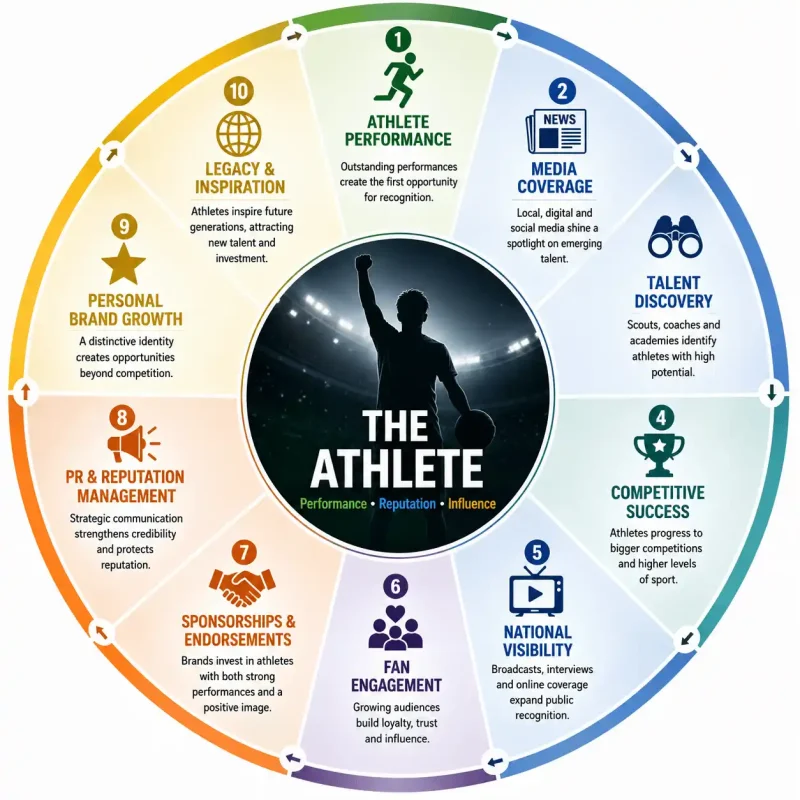
Figure 1. An athlete’s success is built through a continuous cycle where performance drives media attention, visibility attracts sponsorships, strategic PR strengthens reputation, and a strong personal brand creates lasting impact.
Building a Brand Through Endorsements
A big chunk of earnings that a player gets apart from what the player earns from playing the actual sport, comes from endorsements. Marketers are always on the lookout for sportspeople who can be brand ambassadors for their products. Specially athletes’ whose attributes are in sync with those of the brand they’re endorsing.
In today’s scenario, with the ever growing media attention, the attributes they look for in sportspeople as ambassadors go beyond their performances in the arena of play. The image of the player is as important as his/her ability to perform. Crafting a good persona, therefore, is imperative to keep attracting audiences and keep them engaged.
The media, traditional or social, showcases the athlete and his/her image which engages fans and followers, leading to brands being attracted towards them.
The same applies for teams and organizations that are associated with any sport. The more the athlete reaches high’s in his/her career, the more the spotlight is focused upon them. Followers start judging the way athletes behave on and off the arena and how they interact with their fans through the media.
More Than Athletes: Legacy Through Compassion
Fans remember players who go beyond their performances on the arena and make a difference to society by associating themselves with noble causes.
Edson Arantes do Nascimento, a.k.a. ‘Pele’, and Cristiano Ronaldo, the original and current GOATs of football, were discovered from shanty towns of Brazil and Portugal and were born in poverty. They made their mark as all-time greats thanks to their ability to perform consistently and kept setting the bar higher each time they stepped onto the field. What made them icons of the sport they played went beyond their performance as players but what they stood for- their work for charity, compassion and humanity.
Media’s Role in Spotting Hidden Talent
These days, we see a lot of sportspeople from rural areas making their mark in different sports. Stories of their struggle and how they overcame those become the legends that will keep inspiring other athletes to emulate them.
The story of Mahendra Singh Dhoni who came from Ranchi in Jharkhand, rose to become one of the finest players and captains that Indian cricket has seen, is a classic example of the talent that India has, which goes way beyond the urban areas which were considered the incubators of such talent.
When the media brings to the forefront cases like that of Dhoni and other athletes who have made it big despite lack of facilities available in metro regions, it is bound to stir up the authorities, sponsors and talent scouts to flock towards centres that are throwing up talent.
Today, we see many young athletes in various disciplines ranging from track and field to archery and other Olympic sports coming from areas which don’t have the reputation of promoting sports.
Powering the Pipeline: Media’s Push for Grassroots Development
We are well aware that talent development is the first and most vital step towards creating athletes that will fly the flag of our country in the future. Thanks to the push of the media, we now get to know about the hard yards put by athletes and the tremendous work done by coaches, talent scouts and local administrators.
The Indian Premier League (IPL) is mostly full of stories of how parents and coaches have helped young cricketers, belonging to small towns, make it to the big league and take the spotlight away from those coming from metro and urban areas.
Managing Reputation in the Public Eye
Once in the limelight, it is imperative for sportspeople to maintain a positive image to create a good reputation for them to build their own brand. With the burgeoning media, top level players are always in the public eye whether they like it or not.
Every movement made in the public (which can also be a person recording the athlete while sitting in a restaurant) and statements made to the media eventually find their way to the public domain deciding how people form perceptions.
The PR Playbook: Why Athletes Need Communications Support
The role of Communications for the athlete, team and the sports body is vital in the sense that it helps create and guard their image and reputation. As brand custodians, we always advise our clients to be cautious while in public, particularly while engaging with the media.
We help craft out key messages and statements that resonate with what the brand values of our subjects are and what they stand for. Media engagement, in this role, is also an important part of a communications campaign. Most sports authorities/organizations use communications as a key tool towards building a brand.
What to and what not to say in the public is an integral part of the image/reputation building exercise for the athletes. One mishap, intended or otherwise, can cause a big dent to the subjects image which, in some cases, takes time to recover from.
Let me state the example how statements made by Hardik Pandya and K.L. Rahul, two popular cricketers, created an issue which will follow them for the rest of their careers.
On a television chat show, the duo made comments that were misogynistic which led to public outrage and the Indian cricket authorities suspending both players, pending an inquiry. What the cricketers thought was harmless turned out to be totally inappropriate, creating a negative image, leaving them disturbed and ‘scarred’, as Rahul later admitted.
Conclusion
Media, in whatever format, has always been a double-edged sword that can either make or break reputations. Whether at the grassroots level or when the athlete reaches the pinnacle of glory, it is always important for them to understand this statement which is a vital element in their careers.

Related Posts
Nothing Found