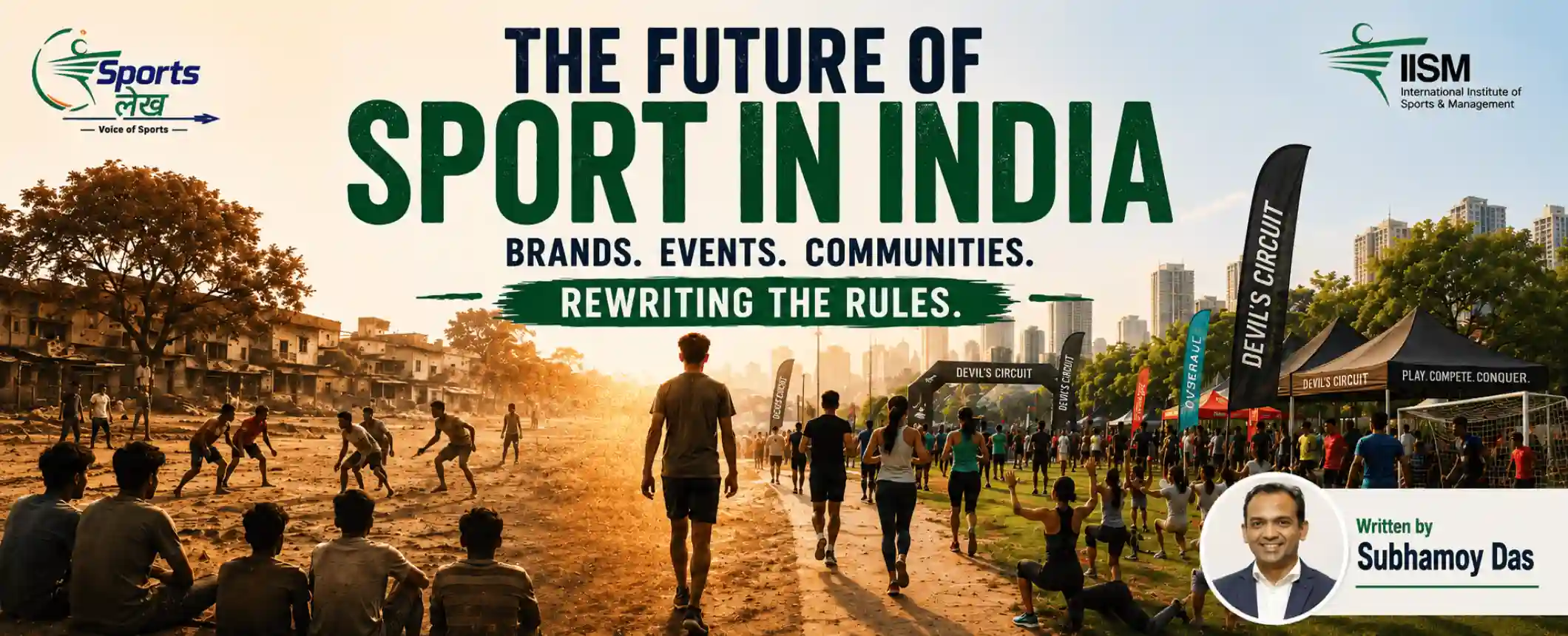
The Future of Sport in India: How Brands, Events, and Communities are Rewriting the Rules

The Evolution of the Indian Sports Ecosystem
I grew up in Dombivli. If you have never heard of it, that is entirely the point! It is a suburb in Thane district, a tangle of railway lines and maidan dust, where middle-class families lived ordinary lives with extraordinary Saturday afternoons.
There were no academies, no social media reels to document the journey. Then, one afternoon, "the game" arrived at our doorstep in a way that changed how I understood sport forever.
A national-level Kabaddi competition descended upon the maidan right in front of my house. I stood at the edge of the field and watched athletes from across the country raid and defend with ferocity. Nobody at that maidan was thinking about grassroots versus elite, amateur versus professional. There was no such distinction.
There was only the contest, the crowd, and the electricity that passed between them. That memory has stayed with me as the truest definition of sport: not a pipeline from the bottom to the top, but a living, breathing ecosystem where participation is the point.
Decades later, that ecosystem is being rebuilt, by brands, by athletes, by communities and the architecture is far more exciting than anything I witnessed on that dusty Dombivli maidan.
How Brands Are Transforming the Indian Sports Industry
Participative sports have done something spectacular. What started off (and continues strong) with Distance Running and Road Races metamorphosed into the "cooler" CrossFit Games and many more. However, of late, HYROX has done something remarkable. By fusing functional fitness with race-day spectacle, it turned a training format into a global movement. Credit where it is due.
But with success comes the rush of imitation. Everyone – organisers, gym owners, brands are now launching some version of a strength-plus-cardio race event, and most of them are forgettable. The ones who are winning are not copying HYROX. They are building events that could only come from them.
Consider three examples from the global stage that deserve attention in every Indian boardroom.
-
BPN Supplements launched the G1M Ultra – a backyard ultra-marathon stretching over three days, built entirely around their brand motto 'Go One More.' It is not a race you finish easily; it is a race you survive by embodying the brand's philosophy.
-
Bandit Running created the Bandit Grand Prix, an F1-inspired race spectacle that channels their underground running culture into pure theatrical energy.
-
Tipster NYC Bakery Run turned a half marathon into a social eating tour, stopping at eight bakeries along the route, a race that doubles as brunch, perfectly aligned with the brand's identity.
These are global examples, but they carry a message that is entirely relevant for India: the most powerful sports event you can build is one that could only come from your brand.
The Rise of Run Clubs as a Lifestyle Movement
Something is happening on the streets of Indian cities every Sunday morning, and it is not just exercise. Run clubs are exploding across the country, transforming from niche fitness groups into massive, highly social lifestyle movements. The engine driving this transformation is largely Instagram and Reels, where the post-run coffee meetup has become as important as the run itself.
In fact, I'm given to understand that Run Clubs are the new Tinder and Bumble of the world! This is not a criticism. It is, in fact, a powerful insight for anyone thinking about sports marketing in India. Run clubs thrive on community, inclusivity, and aesthetic accessibility. They are welcoming to beginners, visually rich, and deeply local.
For advertisers, run clubs represent one of the most authentic and cost-effective activation channels available today. A local run club with 500 passionate members who photograph every session and tag their sponsors is worth more than a stadium banner that no one remembers.
Why Community Sports Events Are Growing in India
If run clubs are the social layer of India's fitness renaissance, then events like the Maruti Suzuki Arena Devils Circuit and The Yoddha Race are the steel frame beneath it. These are not just running events. They are cultural moments that have rebuilt the backbone of participative sport in India.
What makes them remarkable is what they strip away. Inside these races, your designation at work is irrelevant. Your gym membership tier does not matter. Whether you are a corporate executive or a first-generation athlete from a small town, the obstacle course treats you identically.
These events have successfully pulled thousands of participants out of commercial gyms and into outdoor environments where the only currency is grit, discipline, and the willingness to push past your own limits. They are, in the truest sense, the maidan experience scaled for a new India.
How Corporate Foundations Drive Grassroots Sports
Behind the spectacle of races and run clubs, a quieter but equally important story is unfolding. Major corporate foundations are investing in the long game of Indian sport.
The Reliance Foundation has impacted over 23 million children through its sports-for-development initiatives, creating pathways where none existed before. Tata Trusts has been doing this for decades, specifically to build local rural ecosystems – connecting coaches, facilities, and athletes in regions that formal sports structures had long ignored.
These are not CSR checkbox exercises. They are infrastructure investments in the broadest sense.
Sport is a development tool, and these foundations understand that the pipeline from grassroots to glory is built with years of patient investment in communities that rarely make headlines.
From Grassroots to Glory: The Elite Pathway
At the elite end of the pathway, organisations like JSW Sports are demonstrating what a genuine grassroots-to-Olympic model looks like. Their Inspire Institute of Sport (IIS) identifies raw talent from community and regional programmes and provides world-class training, coaching, and infrastructure.
It is the bridge between the Dombivli maidan and the international podium and it works because it is built on a foundation of patient, local talent identification.
Diversifying the Game: New Leagues, New Audiences
The ecosystem is also diversifying rapidly. Platforms like India Khelo Football (IKF) and the Indian Pickleball League (IPBL) are building out local community leagues that offer brands highly localised, measurable grassroots activation opportunities.
These are not the Indian Premier League. Their audiences are regional, their participants are local, and their engagement is genuine rather than passive.
While one might argue that these initiatives lack the reach for brands to cut cheques, going by the proverb, "catch them young and watch them grow", for someone looking for authentic connection rather than borrowed celebrity, emerging sport leagues are where the interesting conversations are happening right now.
Corporate India's Strategic Bet
Perhaps the most under-reported story in Indian sports is the wave of corporate investment flowing into disciplines that sit entirely outside the mainstream.
JKC Sports, for instance, is investing in the Bridge Federation of India, with an explicit mandate to expand the sport of 'bridge' into colleges and schools. It is an unusual bet, but it reflects a broader and important trend: Indian family businesses are entering their second and third generations. As younger leaders look to step out of their predecessors' shadows and write stories of their own, sport has emerged as a powerful canvas.
Simultaneously, brands are recognising that backing an emerging sport offers a level of ownership, authenticity and cultural relevance that is nearly impossible to achieve in crowded, established properties.
The Business Case for Going Local
For marketing and sponsorship professionals, the calculus is increasingly straightforward. Sponsoring a regional or community-level tournament delivers authentic, localised engagement at a fraction of the cost of top-tier events.
Moreover, digital streaming has changed the reach equation entirely. Rural and Tier 2/3 leagues that once played to empty stands now pull in highly engaged digital audiences who are far more invested in the outcome than a casual viewer watching a national broadcast. The grassroots is no longer a limited market, it is a highly fragmented and undiscovered one.
Sport as a Social Investment
The final piece of the picture is ESG and CSR alignment. Investing in youth academies, local training facilities, and especially women's participation opens a dimension of brand value that goes beyond sponsorship.
Programmes like the Pivot Program by Simply Sport, which focuses on expanding women's access to sport, allow brands to fulfill their corporate social responsibility goals while building long-term consumer loyalty with audiences who remember who showed up for them when it mattered.
The Maidan Reimagined
The kid standing at the edge of that Dombivli maidan watching Kabaddi did not know the word 'grassroots.' He just knew that the sport was real, the stakes were high, and the energy was alive.
That combination of realness, stakes, and energy, is what brands, event organisers, and communities are chasing across India today. The good news is that the infrastructure is finally being built to sustain it.
The grassroots has never had more tools, more investment, or more imagination behind it. Glory, as it turns out, grows from the ground up.
About the Author
Subhamoy Das is the National Director of Sports & Entertainment at WPP Media's ESP Division, bringing over 17 years of expertise in media rights, IP monetization and commercial partnerships across India's largest sporting events including the IPL and ICC. His work mainly focuses on how institutional capital can unlock commercial potential of India's sports and entertainment assets.
FAQs
What is driving the growth of the Indian sports industry?
Growth is being driven by grassroots participation, increased brand investment, digital media, new sports leagues, community events, and corporate-backed sports infrastructure.
Why are brands investing in grassroots sports?
Grassroots sports allow brands to build authentic local engagement, create long-term consumer relationships, and support community development.
How are run clubs changing sports marketing?
Run clubs have evolved into community-driven lifestyle spaces where brands can interact with consumers through highly engaged, organic experiences.