How India Can Be a Top-10 Olympic Nation by 2036: Democratizing Sporting Excellence

In India, sporting achievements often supersede the bigger picture of producing excellent sporting talent and the creation of opportunities to uplift our younger generation for excelling in sports. And that’s the major roadblock for which we need to find a roadmap of solutions.
Instead of celebrating isolated moments of excellence, India needs to democratize access to sport across every stage of athlete development. With a population exceeding 1.4 billion and nearly 65 percent of its citizens below the age of 35, there’s no doubt about the extent of India’s talent pool.
The core issue lies in how we lack a system and a robust pipeline of developing that young talent into the medallists & champions we aspire for. For that, grassroots sports development is crucial for developing this talent pipeline, that too, ensuring it is well-supported by sports science sectors and includes all strata of society.
Where Indian Sports Stands Today
Our athletes across various sporting disciplines: from track & field to shooting, badminton, hockey, squash, and several sports certainly have the capabilities to excel on the global stage. India’s performance in Olympic sports — especially by the Paralympic athletes — along with the superb showings in the Asian Games & the 2026 Commonwealth Games also showed how we are improving our consistency in producing podiums & medals across these sports.
However, our overall Olympic medal conversion remains disproportionately low, compared to other leading sporting nations, who have capitalized on their demographic potential in a much better manner. This highlights a critical reality: while elite sporting success is becoming more frequent, the base of India’s sporting pyramid remains relatively narrow.
While governmental support & policy often bears the scrutiny for this whole situation in Indian sports, the recent policy changes are steadily taking steps towards uplifting the country’s sporting landscape. And not just to produce more champions but to create a sporting ecosystem in which every child, irrespective of geography, gender, income, caste, or social background, has access to organized sport and a realistic pathway towards excellence.
Sports Policy Changes in India
Over the last decade, India has witnessed a significant shift in sports policy. While constitutionally being a state subject, the Union government has amplified its strategic support to improving the sporting scenario in the country. The Sports Authority of India (SAI) under the Ministry of Youth Affairs & Sports has been a central organization driving this revolution with programmes such as Khelo India, the Fit India Movement, and the Target Olympic Podium Scheme (TOPS).
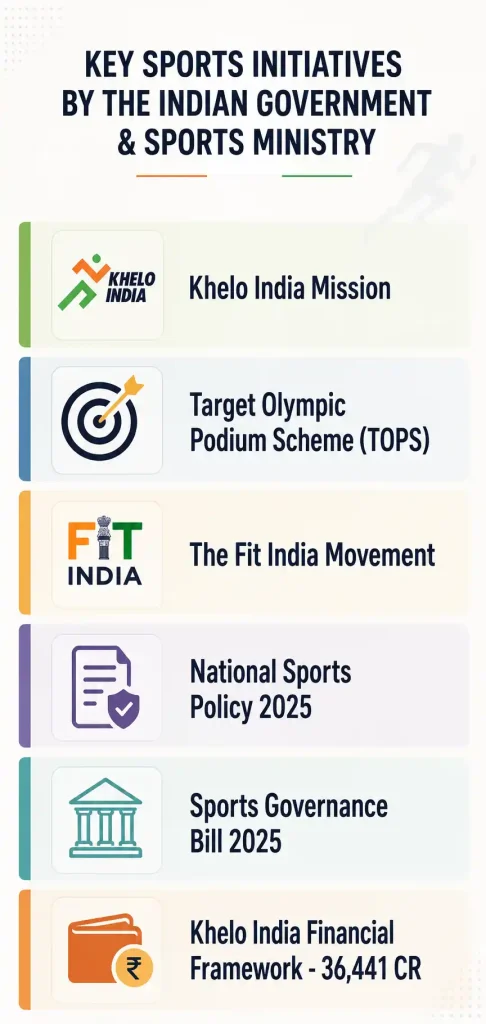
Key initiatives by India’s Ministry of Youth Affairs & Sports (MYAS)
The kind of financial support via scholarships & allowances under Khelo India and several other volunteering and career progression opportunities via Mera Yuva Bharat initiatives is promoting sports as a viable profession. Among these initiatives, Khelo India has emerged as the most comprehensive effort to strengthen the grassroots-to-elite athlete development pathway.
The Khelo India Mission
Through the Khelo India Youth Games and Khelo India University Games, young athletes are being exposed to competition environments comparable to national-level events, especially National Games. And with the spectrum of competitions like the Para Games, Beach Games, Winter Games and Tribal Games, the programme has strengthened talent identification, increased transparency in athlete selection, and created developmental pathways.
The recent Khelo India financial framework has placed budgetary allocations for expanding support infrastructure through Khelo India Centres and State Centres of Excellence. This new framework also includes financial support for coaching, nutrition, education, equipment, and competition exposure. Most importantly, it has attempted to reduce the economic barriers that traditionally prevented talented athletes from pursuing sport seriously.
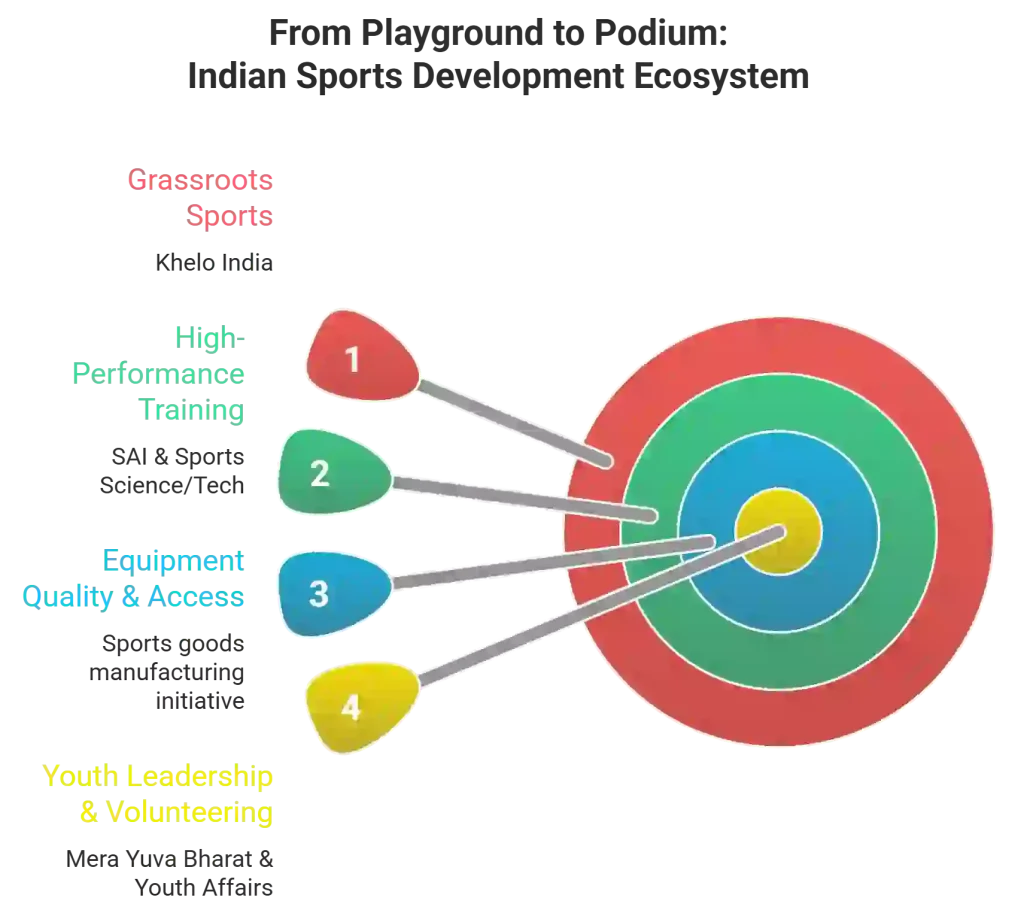
Key Pillars of India’s Sports Development Ecosystem
The Push for Sporting Culture via The Fit India Movement
Parallel to athlete development initiatives, the Fit India Movement has sought to cultivate a national culture of sports & fitness. This is quite relevant for our country, where health issues like obesity, diabetes, cardiovascular disorders along with mental health issues are becoming a major cause of concern.
Under the Fit India Movement, school certifications, workplace wellness programmes, cycling campaigns, marathons, walkathons, community fitness events are promoting physical activity to mitigate these health issues. After all, a fit & physically active society is the foundation that helps groom world-class athletes.
The State-Level Blueprint of Sporting Success
India has several states who have exceeded expectations in sports development & set a high benchmark to follow. Haryana has emerged as India’s most successful sporting ecosystem, contributing the lion’s share of Olympic athletes & international medallists despite housing only about two percent of the national population. Its success stems from a combination of sporting culture, athlete incentives, grassroots competitions, Khel Nurseries, and sustained policy commitment.
Meanwhile, Odisha is taking massive steps in uplifting the sports ecosystem across sports, spearheading with its strategic investments in hockey infrastructure & support systems for the Indian national teams. They are also building high-performance centres and forging international partnerships to level up our athletes across sports like track & field, swimming, badminton, shooting & more.
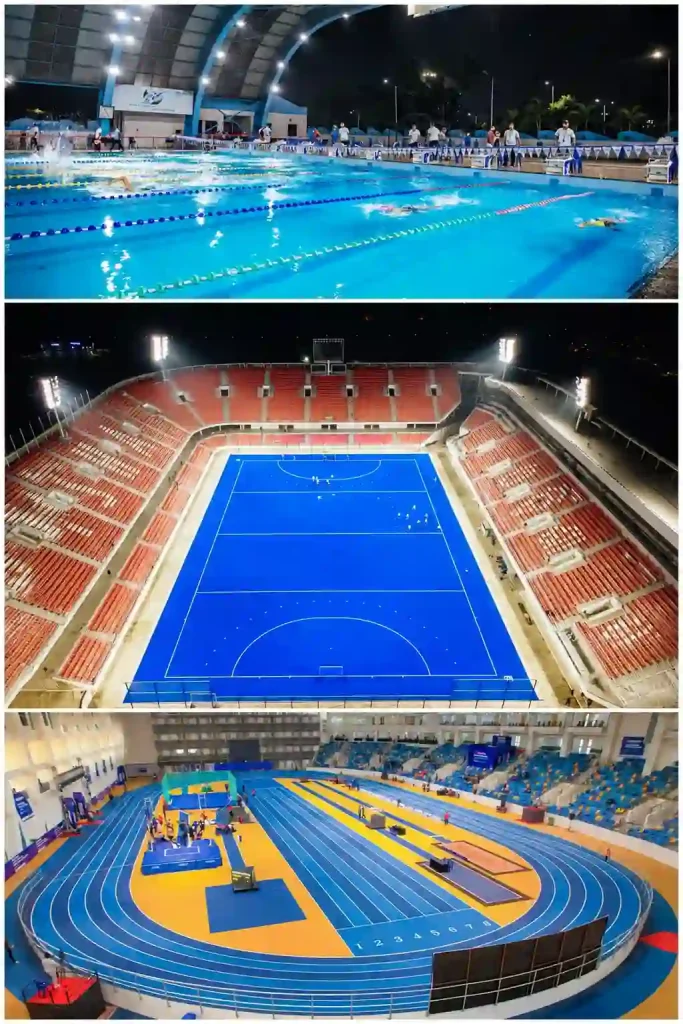
Top-Class Sports Infrastructure in the state of Odisha
Kerala’s achievements underscore the importance of community participation and local sports clubs, while Madhya Pradesh has successfully developed specialized academy-based systems.
The kind of investments being made by Uttar Pradesh, Gujarat, Bihar, and several other states in sports infrastructure are also significantly contributing to developing the ecosystem. The only crucial aspect is to translate these investments into on-ground results & impact on our athletic performance, coaching standards, talent identification, and sports science systems.
And last but not the least, the North-Eastern states continue to produce a rich pool of sporting talent in India. Their consistent contributions across boxing, football, weightlifting, archery, athletics, and combat sports show the need for keeping region-specific approaches to talent development.
The Role of Education in Sports Development
The future of Indian sport will also depend on the integration of sports within the education system. Across the world, schools and universities function as the primary engines of talent identification and athlete development. In India, the National Sports Policy 2025 also aims to emulate those systems at the school & grassroots level.
Now, to execute the NSP 2025’s objective, in collaboration with the Ministry of Education and NCERT, efforts are underway to strengthen physical education and well-being curricula from primary to senior secondary levels. However, curriculum reforms alone will not suffice.
There is a need to have structured competitions, trained physical education teachers, sports infrastructure, athlete scholarships, and seamless pathways linking schools and universities with advanced training centres, which is a dedicated objective outlined under the NSP 2025.
So, sports in schools & universities must therefore be viewed not merely as recreational activities but as investments towards our sporting excellence. On top of that, research consistently demonstrates that participation in sports improves cognitive development in youngsters, develops aspects such as emotional resilience, leadership, teamwork. So, to become a sporting nation, we must start working at the ground level to develop talent via our educational institutions.
Mission Olympics 2036: A National Agenda for Sporting Excellence
For India to become a consistent top-10 nation at the Olympics, we need to clinch around 10 to 20 gold medals. To achieve that, we need to establish a sustainable pipeline of world-class athletes across multiple disciplines. And that needs more than isolated schemes or short-term investments: it requires a comprehensive national mission built upon long-term planning, scientific talent development, institutional accountability, and societal participation.
Nationwide Talent Hunt
The athletes who will represent India at the 2036 Olympic Games are already present in our schools, villages, towns, academies, and communities. That’s why, we need to start scouting & nurturing this talent right now, as highlighted by the Honourable Prime Minister of India, Mr. Narendra Modi.
The first priority must be the establishment of a National Physical Literacy Mission to ensure that every child acquires fundamental movement skills and physical competence during the formative years. Simultaneously, a nationwide scientific talent identification framework should be put in place with aspects such as standardized testing, anthropometric assessments, motor ability profiling, and digital athlete databases.
These aspects are outlined under the latest Khelo India Mission financial framework. Such a system would allow early identification of talent and guide young athletes towards sports best suited to their abilities.
Coaching Development
Besides this, the establishment of a National Coaching Accreditation Board (NCAB) is going to highly benefit the coaching benchmarks in India & develop a brand-new generation of elite sports coaches who match international benchmarks. No sports system can outperform the quality of its coaches, and India requires a substantial expansion in the number, quality, and professional development of coaches across all levels.
Infusing Sports Science
Sports science support should be decentralized and made accessible at district and state levels. Disciplines such as biomechanics, sports medicine, nutrition, psychology, performance analytics, and injury prevention must become integral components of athlete development rather than services reserved exclusively for elite performers. Simultaneously, a seamless school-to-podium pathway must connect schools, universities, academies, Khelo India Centres, State Centres of Excellence, National Centres of Excellence, and elite training programmes.
As for Indian women athletes, they have consistently delivered outstanding performances at international competitions, despite lower participation rates and fewer developmental opportunities. So, fostering more female participation is crucial and that can be done via expanding access to coaching, safe sporting environments, scholarships, and leadership opportunities for women. This could dramatically enhance India’s medal prospects while advancing broader societal objectives.
Conclusion
India stands at an important juncture in its sporting journey. The nation possesses the demographic advantage, economic capacity, technological capability, and political intent necessary to emerge as a major sporting power. The challenge lies in converting these advantages into a coherent and sustainable sporting ecosystem.
The path towards becoming a top-ten Olympic nation by 2036 will not be determined solely by investments in elite athletes or world-class infrastructure. It will depend upon India’s ability to:
-
Democratize sporting opportunity
-
Inculcate scientific talent development
-
Professionalize coaching
-
Integrate sports within education
-
Strengthen grassroots sports participation
-
Create a culture where fitness and sport become a way of life
While we aim to increase our medal tally on the global podium, our overall aim should be to build a healthier, more productive & resilient society, using sports as a vehicle. The true measure of India’s sporting success will not be the number of medals won alone, but the number of children playing, the number of women participating, the number of communities embracing physical activity, and the extent to which sport becomes an integral part of everyday life.
By democratizing sporting excellence and creating pathways from grassroots participation to Olympic podiums, India can convert its vast human potential into sustained sporting success and establish itself among the world’s leading sporting nations by 2047.