What Does It Take to Run the IPL?

Imagine you need to organise your college's biggest sports fest!
You have to:
– Schedule the matches
– Ensure Team participation
– Book the ground
– Approach sponsors
– Manage and appoint volunteers
– Spread the word and bring the audience
Sounds like a lot of work, right?
Now imagine doing the same thing across multiple cities, 10 professional teams, international players, millions of fans, and matches happening almost every day!
Welcome to the IPL.
Organising a league this huge is a massive ordeal!
If you were in-charge of putting the IPL 2027 season together, how would you do it? Let's dive in!
The Core Committee
To organise your college sports fest, the first step is forming a core committee that makes the big decisions.
In IPL, that responsibility sits with the Board of Control for Cricket in India (BCCI) and the IPL Governing Council.
The BCCI owns and administers the league. They:
– Establish the tournament's rules
– Money flow planning
– Oversees operations
– Co-ordinate with the franchises and State Cricket associations
– Make sure the competition follows the required regulations
BCCI basically sets the framework, but they need more professionals to make the event happen!
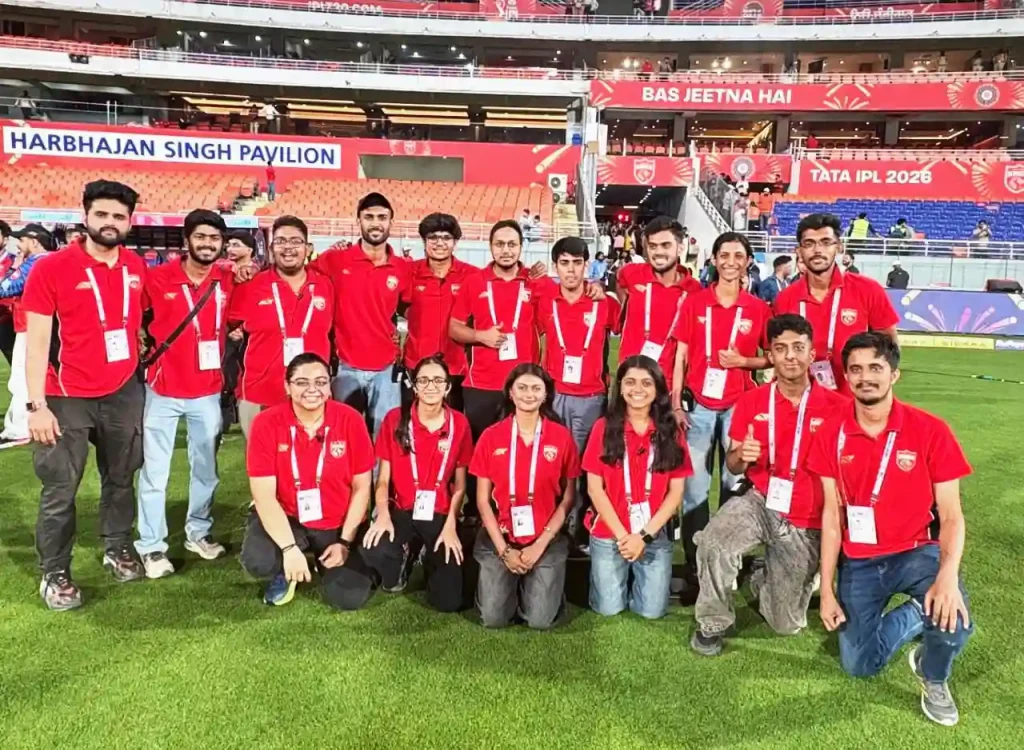
Students at the IPL Internship
But setting the rules and framework is only the beginning. A tournament needs teams to compete, and that's where the IPL franchises come in!
Participation (Teams and Franchises)
A sports fest needs teams that participate!
IPL needs franchises. Currently, there are ten franchises.
Did you know: A team is the group of players and coaches who play the sport, while a franchise is the business that owns and manages the team and its operations within a league.
Each franchise operates its own team. It has:
– Owners
– National and international players
– Team Management Professionals
– Coaches and sports science professionals
– Sponsors, etc.
But how is this team made?
IPL's famous player auction! Before a season commences, the franchises decide which players to retain and which positions they need to fill. This is followed by bidding for available players within the spending limits set by the BCCI.
Once the squad is decided, the franchise organises training, handles contracts, hires required management and science professionals and begin the preparation for the season.
It's a little like registering your college teams, except you're dealing with professional athletes and multi-crore player contracts.
Now that your teams are ready, it's time to get them on the field. But before the first ball is bowled, there's a lot to figure out.
Where will the matches happen? When will each team play? And how will everything fit into one tournament calendar?
The Tournament Timetable and Bookings
Scheduling and losing track of the number of excel sheets we create to mark our tasks are a core memory of organising the college fest.
These tasks include deciding where and when each event will happen.
The IPL has the same requirement, just on a much larger scale!
The BCCI has to organise 74 matches. They have to manage:
– Which team plays on what day
– Availability of Stadiums
– Consider International Cricket, State elections and weather
– Equipments required
Did you know: The IPL uses the Kookaburra Turf White ball, which costs approximately ₹12,000–₹15,000 per ball. Its white colour offers better visibility under floodlights, making it ideal for day-and-night T20 matches. Each innings starts with a new ball, while replacements may be needed due to wear, damage, moisture or balls being hit out of the stadium. Typically, around 6–10 balls are used in a single match.
Unlike a college fest where you might book your campus ground, the IPL uses stadiums across India.
These are generally owned or managed by state cricket associations, which work with the BCCI to prepare them for matches.
Ground staff look after the pitch and outfield. Venue teams arrange dressing rooms, seating, facilities and equipment. And because teams travel between cities, their flights, buses, hotels and practice arrangements need to be planned too.
One match may last a few hours. Getting everything ready for it takes considerably longer.
The Departments
Think about your college fest again.
You'd have separate teams handling:
– PR team
– Marketing
– Registrations
– Tech
– Equipment Team
– Security Team
– Operations Team
The IPL works in a much similar way!
The broadcasters and digital platforms handle the match coverage. They bring in cameras, commentary teams, production crews, graphics and replays so people can watch from home.
Event teams manage the stadium experience: branding, fan zones, ceremonies, hospitality and other on-ground arrangements.
Security teams coordinate with venue authorities and local police to manage entry, crowd movement and restricted areas.
Medical teams remain on standby, while match officials oversee the game itself.
Sponsors also have a role. They partner with the league or individual franchises, and their branding and promotional activities are coordinated across the tournament.
Every department has its own job, but all of them have to work together to make the event successful.
The Match Day
Organising an event should be considered a sport as well, because of the sheer adrenaline and excitement we experience on the final day!
What goes on the match day?
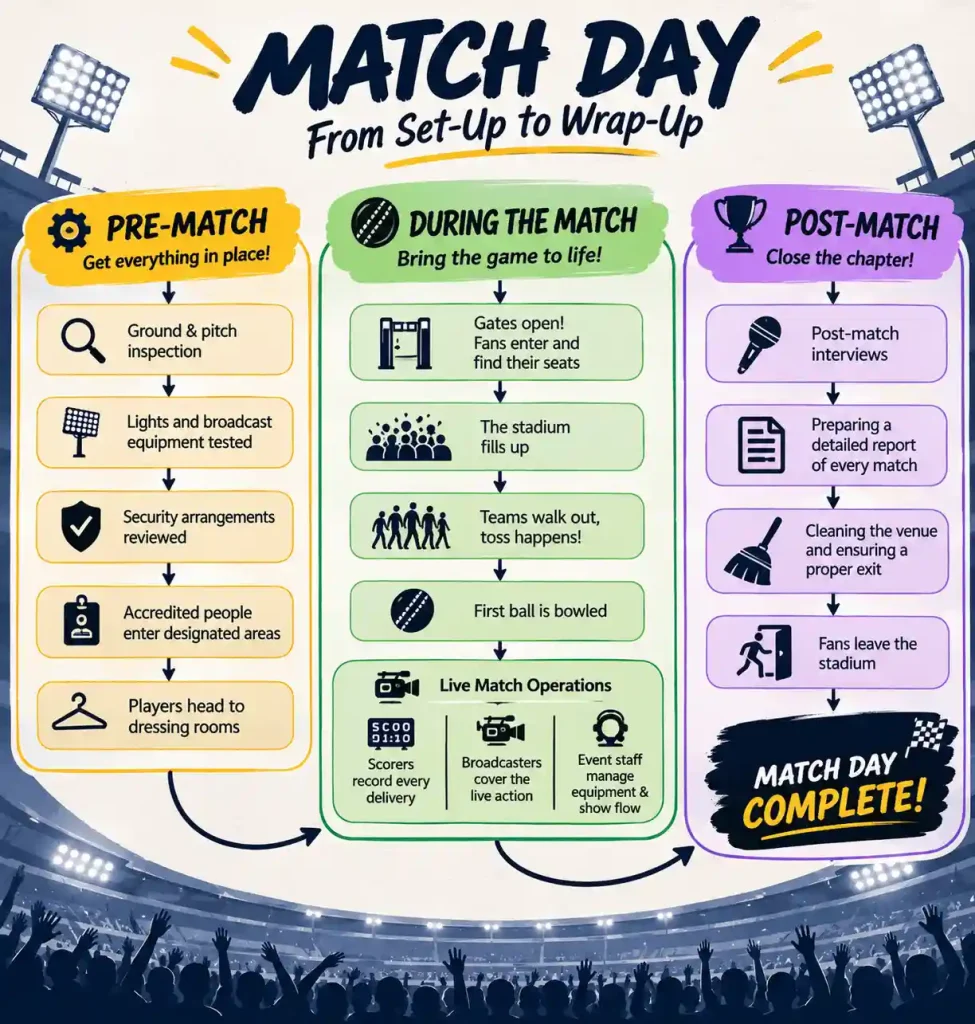
What goes on the match day
The audience sees a cricket match. The organisers are managing an entire event around it.
The League Conclusion
The final is played, the trophy is lifted and the winning team celebrates.
But the organising work doesn't end there.
The franchises review their squads, the BCCI evaluates the season and preparations for the next edition begin.
The next time you watch an IPL match, remember: you're not just watching ten teams play cricket.
You're watching the result of an enormous operation involving people, planning and coordination across the country.
And someone has to make all of it happen!
If being part of the action behind the scenes interests you, explore undergraduate and postgraduate programmes in Sports Management and Sports Science at IISM, Asia's First and Largest Sports Education Institute.
– https://iismworld.com/school-of-sports-management/
– https://iismworld.com/school-of-science/