9 Myths About a Career in Sports in India, Busted
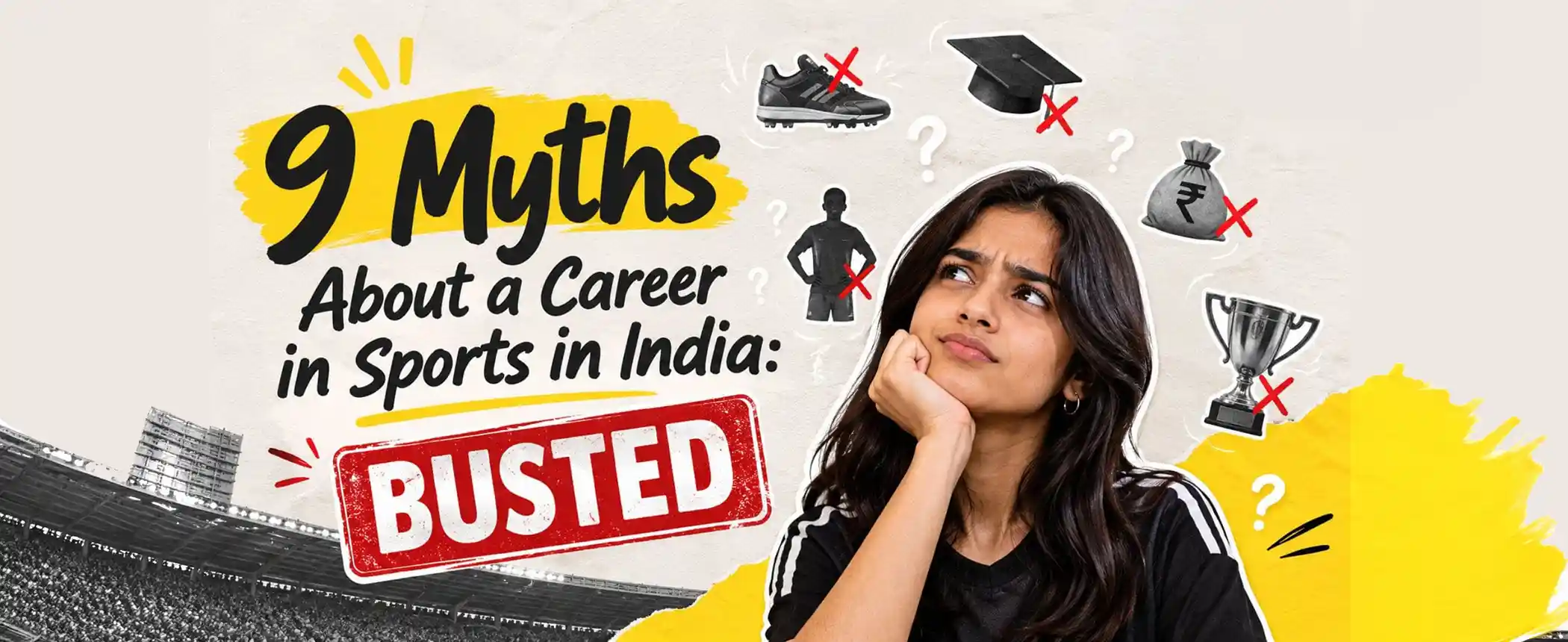
Thinking About a Career in Sports? Let’s Bust 9 Myths First!
What do we do when we enter an overthinking spiral?
Google it!
Whether you’re a student exploring career options, a sports enthusiast, or a parent trying to understand the scope of the sports industry, you’ve probably come across a few questions:
-
Is a career in sports only for professional athletes?
-
Can you earn well in the sports industry?
-
Are there enough sports jobs in India?
-
Do you need to be a sportsperson to work in sports?
And somewhere along the way, you’ve probably heard someone say, “Sports is not a real career.”
Maybe it was a relative. Maybe a teacher. Maybe even your own thoughts at 2 a.m.
Here’s the thing: most of these concerns come from not knowing how the sports industry actually works.
So, before you rule out a career in sports, let’s separate the myths from reality.
Myth 1: A Career in Sports Means Becoming a Professional Athlete
The truth: Athletes are the face of sports, but they aren’t the entire team.
Think about your favourite sporting event. You see the athletes competing, the coaches guiding them and the commentators bringing the action to life.
But have you ever wondered who makes everything happen behind the scenes?
Every athlete’s performance is supported by an ecosystem of professionals, including coaches, physiotherapists, sports psychologists, nutritionists and strength and conditioning coaches.
And that’s just the performance side!
The competition itself requires sports managers, event managers, operations executives, sports marketers, sponsorship professionals, public relations specialists and analysts.
These are all legitimate career options in the sports industry.
In fact, a large part of the sports workforce operates away from the playing field.
Here’s a real-life example.
Aaryan Ugale, a Bachelor of Sports Management graduate from IISM, once dreamed of becoming a professional footballer. When an injury changed his playing journey, he found another way to remain connected to the sport he loved.
He explored sports management and began building a career in the industry.
His journey also changed his mother’s perspective on sports as a profession. Initially unsure about the field, she gradually became one of its proudest advocates.
Her explanation to people questioning what her son did was simple:
“Do you watch matches on TV? Behind every match is a big team. My son is that team.”
And that pretty much sums it up!
A career in sports doesn’t necessarily mean being the person scoring the winning goal. You could be the person organising the tournament, managing the team, analysing performance or building the brand behind it.
View this post on Instagram
Myth 2: If You Didn’t Play Sports at a Professional Level, You Won’t Make It
The truth: Playing experience can help, but it isn’t a compulsory entry ticket to the sports industry.
Let’s get one thing straight: you don’t need a cabinet full of medals to build a career in sports.
Of course, playing experience can help you understand the game, its rules, its challenges and the mindset of athletes.
However, the sports industry also needs professionals with skills in:
-
Sports marketing and communication
-
Sports business and finance
-
Sports analytics and data interpretation
-
Event management and operations
-
Sports journalism and content creation
-
Sports law and administration
-
Sports science and performance research
A person who has never played professional cricket could still build a career in cricket analytics, sports marketing or team management.
Similarly, someone with an academic background in biology or physiology could explore sports science and performance-related careers.
What matters is understanding the industry, developing relevant skills and gaining practical experience.
You don’t have to play the game professionally to build a profession around it.
Myth 3: There’s No Money in the Sports Industry
The truth: Sports offers paid career opportunities across several sectors, although salaries vary by role, experience and expertise.
One of the biggest concerns students and parents have is whether a career in sports can provide financial growth.
And it’s a fair question!
But here’s something worth considering: the sports industry isn’t powered by ticket sales and television appearances alone.
It operates through several business verticals, including:
-
Sports sponsorships and brand partnerships
-
Broadcasting and media rights
-
Sports leagues and franchises
-
Sports merchandise and licensing
-
Sporting events and tournaments
-
Sports technology and analytics
-
Athlete and team management
Each of these creates professional opportunities.
Like most industries, entry-level salaries may be modest.
However, compensation can grow with experience, specialisation, industry knowledge and professional networks.
The important thing is to look beyond the earning potential of athletes and understand the business opportunities that power the sports ecosystem.
Myth 4: Sports Careers Have No Stability
The truth: The career span of an athlete and the career span of a sports professional are two very different things.
When people discuss the uncertainty of sports careers, they often think about an athlete’s playing career.
Injuries, competition, selection pressure and physical demands can influence how long an athlete remains professionally active.
But what about the people working in sports management, sports science, marketing or administration?
Their careers follow a different professional trajectory.
A sports management professional can grow from an entry-level executive role into positions involving team management, event operations, sponsorships, business development or sports administration.
Similarly, a sports science professional can specialise in areas such as exercise physiology, sports nutrition, performance analysis and strength and conditioning.
As the sports ecosystem develops, specialised knowledge and professional experience become increasingly important.
Of course, no industry can guarantee complete job security. However, a career in sports offers multiple professional pathways beyond an athlete’s playing years.
Myth 5: Cricket Is the Only Sport With Career Opportunities in India
The truth: India’s sports ecosystem extends far beyond cricket.
Cricket might dominate television screens, but it isn’t the only sport creating professional opportunities in India.
Over the years, leagues and competitions across different sports have expanded the country’s sporting ecosystem.
Consider the opportunities emerging from:
-
Football: Indian Super League (ISL) and other football competitions.
-
Kabaddi: Pro Kabaddi League (PKL).
-
Badminton: Professional tournaments and national-level competitions.
-
Athletics: Marathons, track and field events and grassroots initiatives.
-
Hockey: Domestic competitions and international tournaments.
-
Motorsport: F1 coming to India, Racing events, teams and sponsorship opportunities.
-
Esports: Competitive gaming, event production and digital communities.
Beyond leagues, events such as the Tata Mumbai Marathon, HYROX India, Khelo India Games and pickleball competitions create opportunities across event management, marketing, sponsorships, logistics and operations.
Government initiatives and investments in sports infrastructure, grassroots participation and athlete development also contribute to the wider ecosystem.
India’s preparations to host major sporting events, including the 2030 Commonwealth Games, further highlight the importance of developing professionals who can support the industry.
So, if cricket isn’t your favourite sport, don’t worry. There is a much bigger playing field to explore!
Myth 6: Sports Careers Are Only for Men
The truth: Women are building successful careers across the sports industry, both on and off the field.
If Indian women are making their mark on the playing field, why should professional opportunities off it be any different?
Women work across sports marketing, team management, broadcasting, sports science, operations, analytics, administration and several other verticals.
There are also international examples of women breaking barriers in traditionally male-dominated sporting environments.
Kim Ng made history as the first woman to serve as General Manager of a Major League Baseball team when she joined the Miami Marlins.
Mandira Bedi helped bring greater visibility to women in sports broadcasting through her cricket presentation during the 2003 ICC Cricket World Cup.
In an interview featured by IISM, Vaidehi Vaidya, Founder & MD of Women in Sports India (WISI), also highlighted the need to improve awareness about sports careers among young women and encourage them to explore relevant education and professional certifications.
Her larger point is important: women need to know that opportunities in sports extend beyond becoming professional athletes.
A career in sports should be about your abilities, interests and skills, not your gender.
Myth 7: You Can Only Enter the Sports Industry Through Connections
The truth: Networking helps, but your skills and experience give people a reason to remember you.
Let’s be honest. Networking matters in the sports industry, just as it does in most professional fields.
But connections alone cannot replace professional competence.
If you’re looking to build a career in sports, start by developing the skills required for your chosen field.
Here are a few practical ways to get started:
-
Explore internships: Get exposure to sports organisations, leagues, teams and event companies.
-
Volunteer at sporting events: Understand how tournaments and competitions operate.
-
Build a portfolio: Showcase your work in sports marketing, content, analytics or event planning.
-
Learn industry tools: Develop relevant technical and professional skills.
-
Attend industry events: Interact with professionals and understand how the sports ecosystem functions.
A relevant educational programme can also help you build foundational knowledge and access practical learning opportunities.
At IISM, industry interactions, masterclasses, internships and practical exposure are integrated into the learning experience to help students understand the professional side of sports.
Remember, networking can open a door. Your knowledge and work help you make the most of the opportunity.
Myth 8: Passion for Sports Is Enough to Build a Career
The truth: Passion gets you started. Skills, education and experience help you build a career.
Loving sports is a great starting point. But professional success requires more than knowing every cricket statistic or remembering the score of your favourite football match.
Think about a cricket team.
Every player understands the fundamentals of batting, bowling and fielding. However, each player develops specialised strengths through consistent practice and training.
The same principle applies to the sports industry.
A sports management professional needs to understand different aspects of the business, including marketing, finance, sponsorships, operations and administration.
A sports science professional needs a foundation in areas such as anatomy, physiology, biomechanics, sports psychology and nutrition.
You may eventually specialise in one area, but understanding how the different components work together makes you a more capable professional.
This is where structured education and practical learning become important.
At IISM, students pursuing Sports Management and Sports Science programmes are introduced to the different dimensions of their chosen fields through classroom learning, industry interactions and practical exposure.
Because passion might tell you which direction to take, but professional skills help you move forward.
Myth 9: Athletes Don’t Need a Backup Career Plan
The truth: Planning for life beyond competitive sport is just as important as planning for performance.
For many athletes, sport is more than a hobby. It is their identity, routine and biggest ambition.
But professional sporting careers can be unpredictable.
Injuries, selection challenges, physical demands and changing priorities can influence an athlete’s playing journey.
And transitioning out of competitive sport isn’t always easy.
This is why exploring career opportunities alongside an athletic journey can be valuable.
Imagine being able to stay connected to the sport you love, even when you aren’t competing.
An athlete interested in the business side of sports could explore sports management, team operations, marketing or athlete representation.
Someone interested in performance and recovery could explore sports science, strength and conditioning, sports nutrition or performance analysis, subject to the relevant qualifications and professional requirements.
These fields allow individuals to apply their understanding of sport in a different professional capacity.
It is also important to remember that skills developed through sporting experience, such as discipline, teamwork, adaptability and decision-making, can be valuable across industries.
Your sporting journey doesn’t have to end when your playing career does.
IISM currently has 257+ National and International athlete students pursuing their sports education with us!
So, Is a Career in Sports Worth Exploring?
A career in sports is much bigger than most people realise.
From managing professional teams and organising international tournaments to analysing athlete performance and building brand partnerships, the industry offers opportunities for people with different interests, educational backgrounds and skill sets.
If you’re considering a career in sports, start by focusing on three things:
-
Identify your interests: Are you drawn towards the business, management, science, technology or creative side of sports?
-
Develop relevant skills: Build the knowledge and professional capabilities required for your chosen field.
-
Get practical exposure: Look for internships, volunteering opportunities, industry interactions and hands-on learning experiences.
And if you’re wondering where to begin, that’s where the right educational foundation can make a difference.
Explore a Career in Sports With IISM
The International Institute of Sports & Management (IISM), Mumbai, is Asia’s First and Largest Sports Education Institute, with 16 years of experience in sports education.
IISM offers undergraduate and postgraduate programmes in Sports Management and Sports Science, in collaboration with the University of Mumbai and GICED.
Its learning approach combines academic knowledge with industry masterclasses, practical exposure, internships and opportunities to understand how the sports ecosystem functions.
Whether you want to work behind a sporting event, manage a professional team, understand athlete performance or explore the business of sports, your journey can begin with the right education.
Because you don’t have to be on the field to make a mark in sports.
Explore the programmes at IISM and discover where a career in sports could take you.