Impact of the National Sports Policy 2025 Decoded
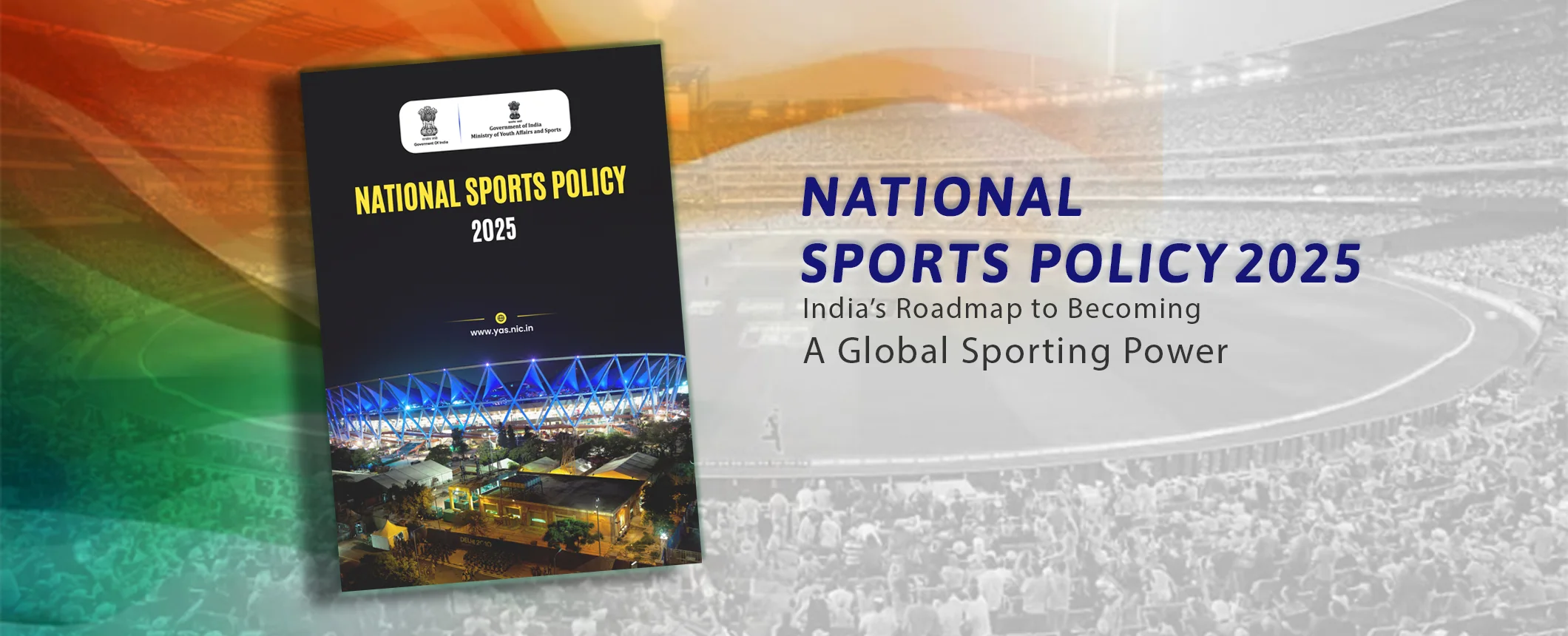
India’s sporting power is rising with consistent success across sports at the international level. Beyond the podium though, this success is also transforming various facets in the sports ecosystem. Now, to harness the potential of sports to drive societal progress and economic growth, the Government of India introduced the National Sports Policy 2025 (NSP) 2025.
Having recognized the powerful potential that sports can bring to the overall well-being of the nation’s citizens, the Ministry of Youth Affairs & Sports introduced this NSP last year. And the Union Cabinet approved it on July 1st, 2025, as it presents a transformative roadmap: “Sports for Nation Building”.
It strives to invigorate sports culture from grassroots to global elite, promoting economic growth, social inclusion, health, education, and positioning India as a world sporting power in the future, eyeing to host the 2036 Olympic Games.
So, let’s dive deep into what the National Sports Policy 2025 entails & also understand its impact with the various initiatives, budgetary allocations & sports governance actions undertaken in the past year since the NSP was introduced.
What is the National Sports Policy (NSP) 2025?
The National Sports Policy has set forth an extensive list of objectives that aim at three major aspects:
Grassroots & Inclusion
- Establish comprehensive sports programs for all levels — from grassroots to elite.
- Organize competitive leagues at community, district, and national levels.
- Impart physical fitness literacy and sporting awareness.
- Ensure equitable access to sports infrastructure across regions.
- Integrate educational institutions as feeder ecosystems.
- Enable sports as a career pathway, especially for youth.
Elite Excellence & Performance
-
Develop a strong talent identification and athlete development system.
-
Offer athlete-centric support like coaching, sports science, sports medicine, and welfare.
-
Promote sports science, sports medicine, innovation, and research.
Governance & Commercial Economy
-
Strengthen governance and institutional frameworks.
-
Revamp funding mechanisms for sustainability.
-
Encourage sports industries and startups.
-
Recognize champions and retired athletes through rewards and recruitment.
Five Pillars of National Sports Policy 2025
Excellence on the Global Stage
India is on a mission to nurture world-class athletes, starting from the grassroots up to Olympic podiums. The policy aims to:
-
Spot and support early talent — whether in cities, villages, panchayats, or schools — and guide them through structured local to elite leagues.
-
Build high-quality training systems, backed by sports science, expert coaching, nutrition, medicine, and psychology.
-
Upgrade the skills of coaches, referees, and support staff, and reform sports federations (NSFs) to function professionally and transparently.
Together, this ensures every promising athlete is supported with world-standard care from day one.
Sports for Economic Development
Sports play a pivotal role in driving economic development. So, promoting economic development through sports includes various measures like tourism, entrepreneurship, manufacturing, etc.
-
India is giving a boost to sports tourism, equipment manufacturing, startups, and entrepreneurship through public and private collaboration.
-
Programs like “One Corporate – One Sport”, PPPs, and CSR funding are helping build business opportunities in sporting goods, tech, and service sectors.
-
Hosting big international events and launching franchise-based leagues is creating jobs and stimulating local economies.
This pillar seeks to turn sports into a vibrant, self-sustaining growth sector.
Sports for Social Development
By leveraging sports as a unifying force, global peace, mutual understanding, and inclusivity can be promoted. Emphasizing these ensures that all individuals, regardless of their background, have equal opportunities to take part in sports leagues and events.
This inclusive approach, with efforts further promoting sports careers and educational pathways, creates a path for the development of youth, empowering them to achieve their full potential and contribute to society.
-
The policy actively encourages participation from women, tribal and economically disadvantaged communities, and persons with disabilities through targeted outreach programs.
-
Traditional and indigenous games are being revived and promoted as community heritage.
-
Flexible pathways, mentoring, and dual-career support make sport a viable profession rather than a dream.
This transformative outreach helps sports break social barriers and open new opportunities.
Sports as a People’s Movement
Sports can transform into a powerful people’s movement by addressing pivotal aspects of physical and mental well-being while serving as an entertainment activity. There’s no debate that prioritizing physical health through sports improves overall fitness, reduces healthcare costs, and promotes a healthier lifestyle. Sports also play a significant role in developing mental health. Regular physical activity reduces stress, anxiety, and depression.
-
Campaigns like Fit India and community festivals encourage families, schools, and workplaces to adopt fitness as a norm.
-
A “fitness index” for educational institutions and offices will encourage healthier lifestyles and friendly competition.
-
Public access to inclusive sports infrastructure—from school grounds to open gyms—aims to weave sports deeply into everyday culture.
This pillar turns movement into culture, turning participation into a shared public identity.
Integration with National Education Policy – NEP 2020
To achieve alignment between the NSP 2025 and the National Education Policy (NEP) 2020, multiple key focus areas will be addressed. To integrate sports and physical education seamlessly into the overall curriculum, a framework and delivery of sports modules for the holistic education program will be facilitated.
-
Physical Education is being brought into the mainstream curriculum, with certified training for PE teachers and eco-friendly facilities nationwide.
-
Schools and colleges become talent incubators, where sports and classroom learning happen side-by-side.
-
Dual-career strategies, flexible policies, and recognition of sports achievements aim to balance academic progress and sporting ambition.
This reconciliation allows every student to pursue both education and athletics without compromise.
Across all five pillars, the vision is simple yet powerful: to empower individuals, transform communities, and reimagine sports not just as a professional ambition but as a source of pride, opportunity, and health.
Impact of National Sports Policy 2025 ft. Sports Budget, Khelo India
The Ministry of Youth Affairs & Sports (MYAS) has been quite proactively implementing the set objectives of the National Sports Policy for the past year. It is mainly evident in the FY2026-27 Union Budget, which allocated a record ₹4479.88 crores for the sports budget. This is India’s highest-ever sports budget, seeing a 18 percent Y-o-Y increase from FY2025-26.
The Sports Budget Boost
The key highlights of this budget involve extensive funding increase to the Sports Authority of India (SAI), which has been the backbone of India’s athlete development & sports ecosystem from the grassroots to the elite level. Around ₹917 crores were allocated to SAI, whereas the Khelo India initiative was also allocated ₹924 crores.
To put into context, India’s entire sports budget was around ₹1400-1500 crores back in 2015-16. So, to have that much amount of money invested in SAI & Khelo India alone highlights the significance of these two pillars of Indian sports.
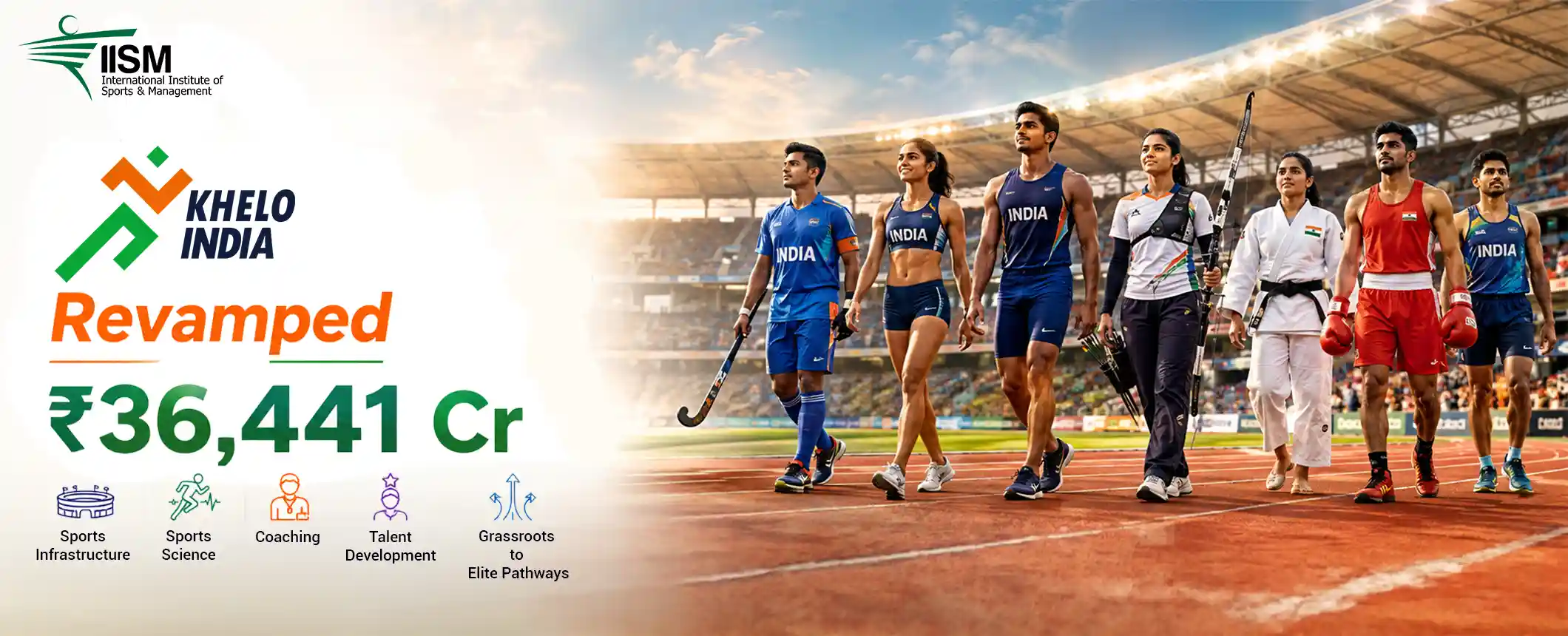
This sports budget has also upgraded Khelo India as a ‘Mission’ and accordingly the Union Cabinet has provided a dedicated financial framework for the same. ₹36,441 crores have been allocated out of which ₹29,054 crores to forming a dedicated Khelo India pipeline for athlete development from top to bottom.
If we look at the breakdown of this budget for Khelo India, it aligns well with several pillars of the NSP, the grassroots level development in schools & inculcating sports culture in people along with strengthening India’s excellence on the global stage.
Building a Sports Culture & Talent Pipeline
By establishing Khelo India Feeders Schools (KIFS), Khelo India Utkrishta Vidyalayas (KIUV), Khelo India Centres (KIC) & Khelo India Rising Talent Identification (KIRTI) programmes, the grassroots development & community building aspects will be taken care of. A huge chunk of the budget will help develop a feeder pipeline of talent from every nook & corner of the country.
There on, the vision to establish:
-
Khelo India Centres of Excellence (KICoE)
-
SAI Training Centres (STCs) — (which already exist & can be further expanded)
-
Khelo India Accredited Academies (KIAA) and
-
Armed Forced Youth Sports Companies
will massively boost the athlete development aspect & bridge the gap in India’s top-level athletic pool across sports. And there on, the National Centres of Excellence (NCoEs) run by SAI, the Target Olympic Podium Scheme (TOPS) alongside the National Sports Federations do exist to uplift the elite level of Indian athletes & sports ecosystem overall.
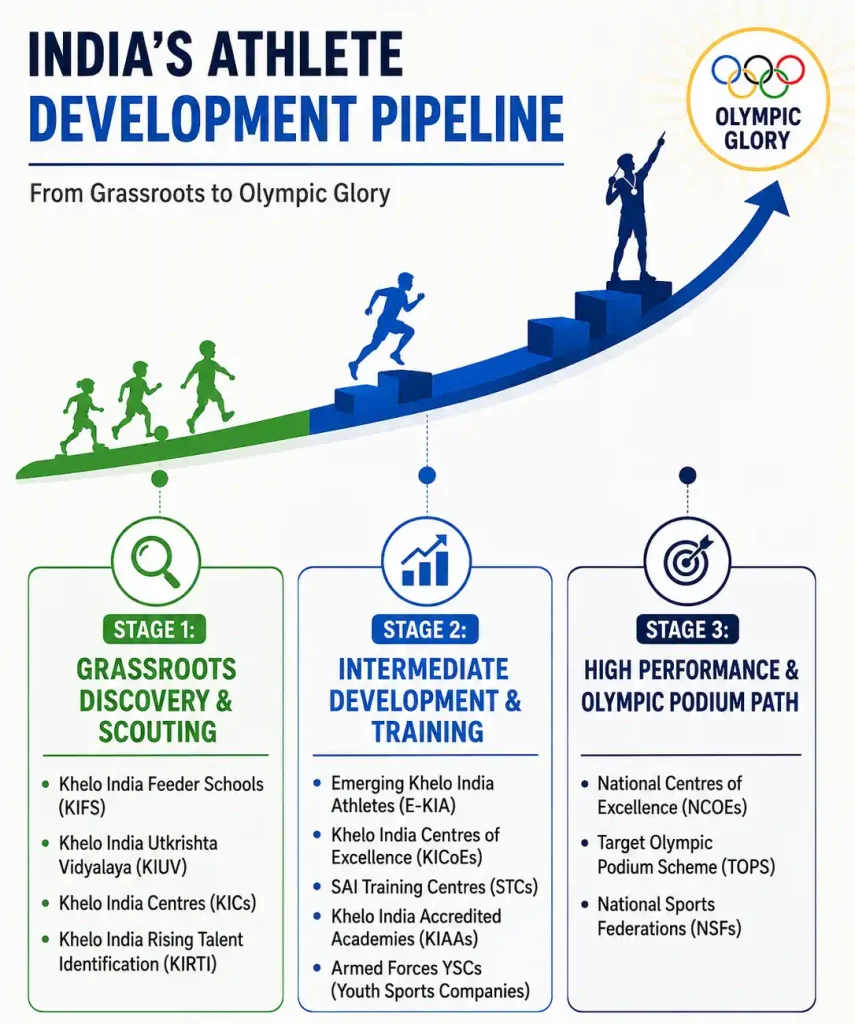
India’s Athlete Development Pipeline – Khelo India
Creating a Sports-Driven Economy
Strengthening the sports business sector is also one of the crucial pillars of the NSP 2025. Utilizing sports as a vehicle to drive economic development in India has been one of the most ambitious objectives set by the Sports Ministry and they are working towards the same.
The 2026-27 sports budget saw a fresh funding allocation of ₹500 crores towards the promotion of sports goods manufacturing in the country. This allocation primarily is to push indigenous sports goods & equipment, which in turn will create plenty of job & business opportunities in this sector.
Similarly, other verticals of the sports industry such as sports retail & sports tourism are also being rallied as major growth engines to create sports-driven economy in India. Merchandise sales, tourism & hospitality packages for Indian & international sporting events & competition are rising steadily.
And most importantly sports technology start-ups will be another major point of focus to facilitate the sports science push in uplifting India’s athletes as intended via the National Sports Policy 2025.
Naturally, the Sports Ministry will look to increase budgetary allocations on these areas as well as we aim to become a sporting hub by the time the 2036 Olympics happen.
Stricter Regulations on National Sports Federations (NSFs)
To enforce & execute the set objectives of the NSP, the National Sports Governance Act was passed in 2025, which puts forth elaborate regulations for national sports federations & sets up various aspects such as a National Sports Board & a National Sports Tribunal.
The major impact, however, has been seen across India’s various national sports federations (NSFs) such as Hockey India, Table Tennis Federation of India, Kho Kho Federation of India, Boxing Federation of India and several such national federations. Some of these sports’ national governing bodies have faced stern action by the Ministry of Youth Affairs & Sports for a lack of governance structure & frequent lapse in their functioning. Meanwhile, the MYAS has also granted official recognition as an NSF to federations like FMSCI (Federation of Motor Sports Clubs of India), which governs motorsport disciplines in the country.
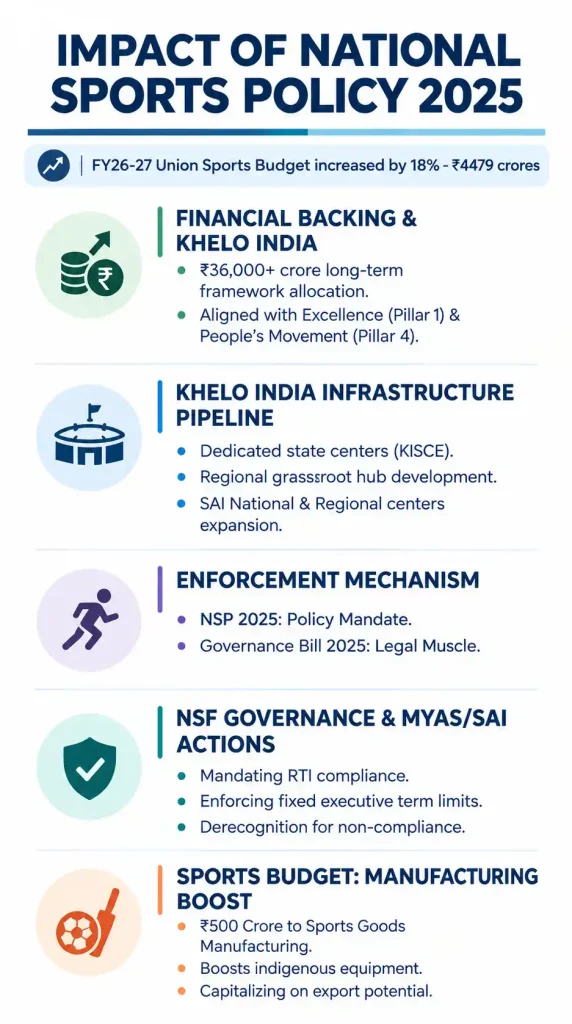
Impact of National Sports Policy – NSP 2025 Summarized
Overall, the Sports Governance Bill is the legal muscle which will enable a smoother execution of the National Sports Policy, especially on the federations’ front. The upside is apart from the funding of ₹425 crores in the Annual Sports Budget for FY2026-27, the NSFs have also been allocated around ₹7,387 crores as part of the above mentioned Khelo India financial framework worth ₹36,441 crores.
Frequently Asked Questions (FAQs)
Conclusion:
The National Sports Policy 2025 is a visionary blueprint aiming to transform India's sporting future. And over a year since its introduction, the steps taken by the Ministry of Youth Affairs & Sports has steadily contributed to its execution & making a difference via its five strategic pillars.
Together with the Sports Governance Act, the Union Sports Budget, the Khelo India Mission & its financial framework, the NSP 2025 has started showing its effects across: grassroots development, economic opportunity, social equity, mass engagement, and educational integration.
Time will tell whether it fulfills the overall aim of making India a global sporting destination by Olympics 2036 and a sporting powerhouse by 2047. As of now, the Union & State governments, MYAS, SAI and all the public & private stakeholders across India's sports ecosystem seem to be aligned with the National Sports Policy as a comprehensive movement toward sports-driven nation-building.