Cricket’s Rich List 2026: Inside IPL, WPL & The Stories Behind the Salaries
“The numbers are easy to find. What’s harder to find is what they mean: for the players carrying them, the teams betting on them, and the sport being reshaped by them.”
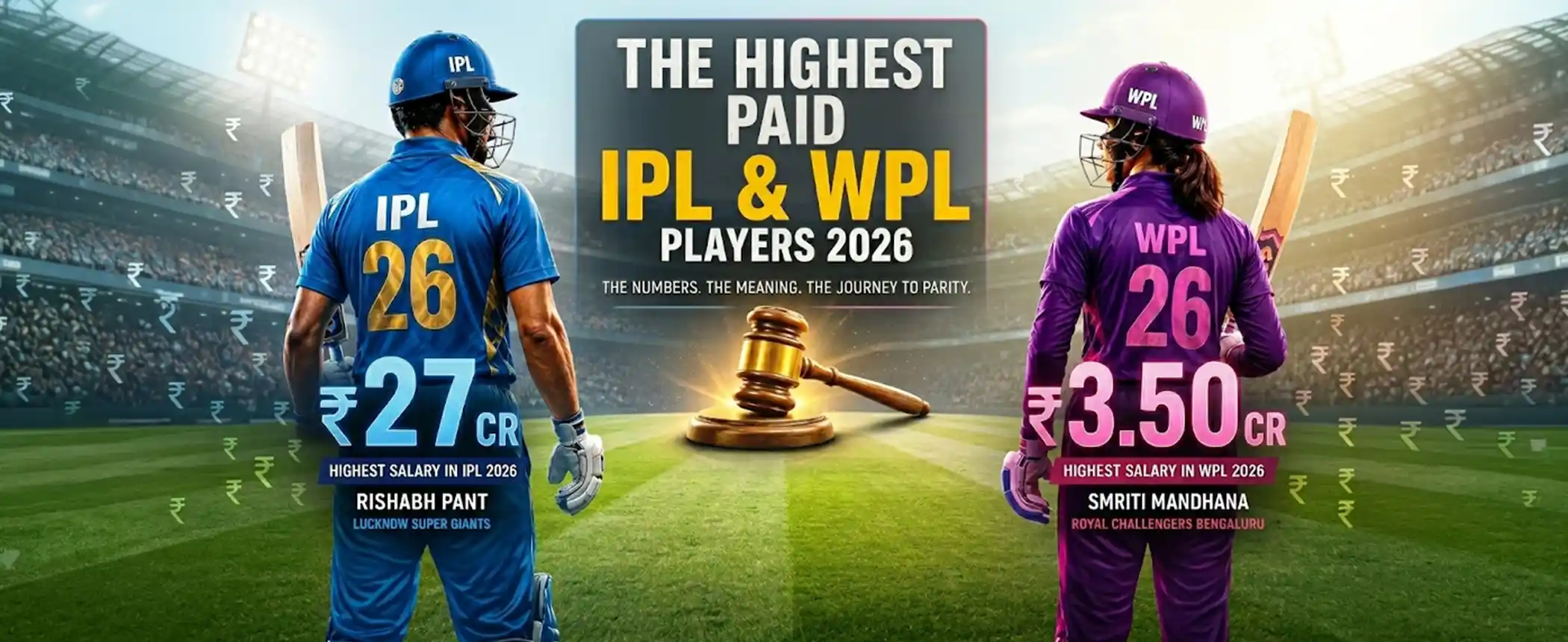
The IPL 2026 mini auction, held at the Etihad Arena in Abu Dhabi in December 2025, saw 77 players bought for a combined ₹215.45 crore, smaller in volume than a mega auction, but no less dramatic. Meanwhile, the WPL 2026 mega auction in New Delhi set a fresh salary ceiling, with three players retained at ₹3.50 crore and new stars breaking records on the floor.
This piece goes beyond listing salaries. It captures the key 2026 figures, explains the structural forces behind them, and places IPL and WPL earnings within global sports economics.
It’s structured in three parts: first, the headline numbers; second, decoding what those numbers mean; and third, the supposed parity between the two.
This is a clear picture of what cricket pays in 2026 and why:
Before the Numbers: The Price – Pressure – Performance Loop.
A salary list tells you what someone earns. It doesn’t tell you what that earning does to them, to their role, their visibility, their relationship with expectation. That’s what this framework captures.
Think of it as a cycle. It starts the moment the auction hammer falls and doesn’t stop until the final is over.
1. Price
₹27 crore or ₹3.50 crore: the auction prices aren’t just salaries. They are public declarations of what the franchise believes the player is worth. The moment this price is announced it sets a benchmark for everything that follows.
2. Increased Expectations
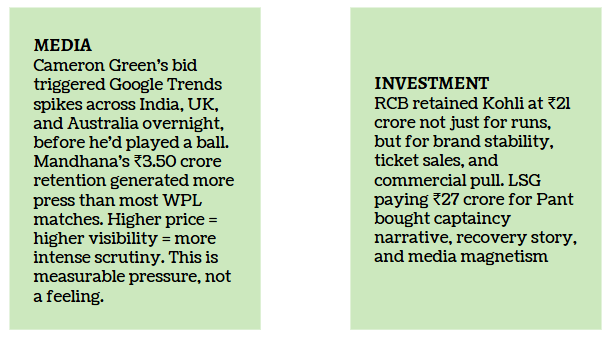
The price the player is bought at, defines the greatness expected off them. A 2 crore player’s bad day is quietly noted whereas a player valued at 27 crore performing badly becomes the front page news next day. The benchmark is set before a ball is bowled.
3. Role expansion
High-paid players are deployed in crunch situations, given multiple roles, and trusted in the moments that win or lose matches. The pressure is structural. It is built into how they’re used, not just how they’re perceived.
4. Narrative: Worth it or Overpriced?
Strong season: “Worth every rupee.” Difficult patch: “Overpriced.” The narrative locks in, and feeds directly into the next auction cycle, the next retention decision, the next expectation baseline.
The loop begins again.
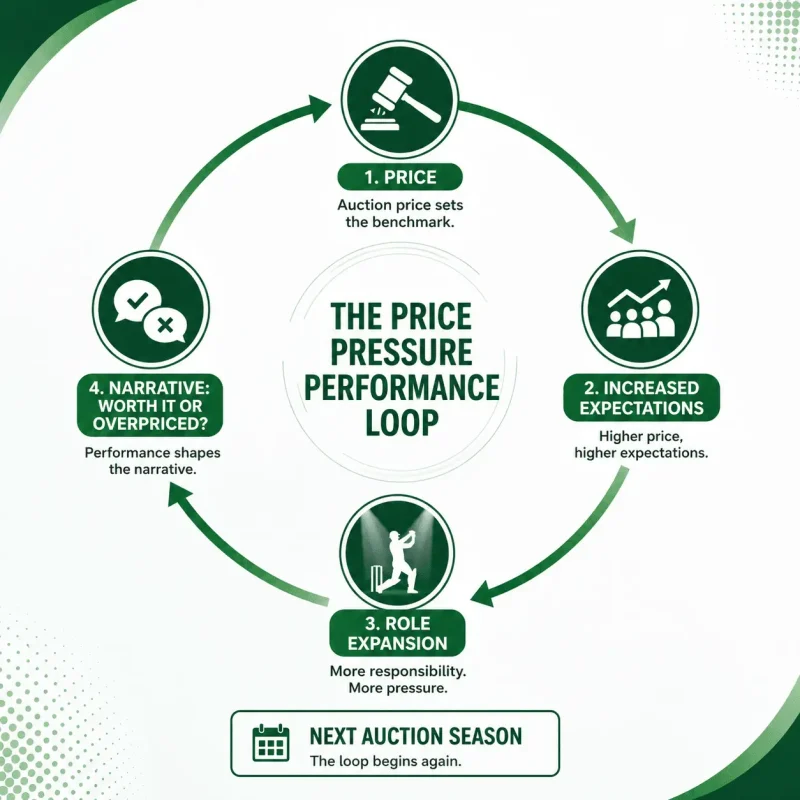
The Price-Pressure-Performance Loop
With that framework established, here are the players living inside it in 2026.
The Current Numbers:
IPL 2026: Complete Salary Rankings
The 2026 cycle carries forward retentions from the 2025 mega auction combined with December 2025’s mini auction in Abu Dhabi. One landmark rule change defines this season:
🔑 New for 2026: The Overseas Salary Cap
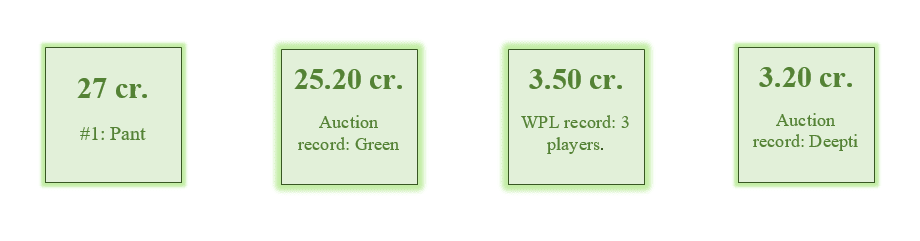
When KKR bid ₹25.20 crore for Cameron Green, a new all-time overseas auction record, Green received only ₹18 crore. KKR’s purse was deducted ₹25.20 crore, while the remaining ₹7.20 crore went to BCCI’s development program. This rule applies to all overseas players and changes the calculus of every overseas bidding war going forward.
The new rule comes with its supporters and rebels.
Critics call it an artificial suppression of player rights. Supporters argue it protects the Indian player salary structure and prevents overseas stars from dominating the top earner list.
Whichever side you take, other sports leagues are paying attention to it to see how it works.
The new rule comes with its supporters and rebels.
Critics call it an artificial suppression of player rights. Supporters argue it protects the Indian player salary structure and prevents overseas stars from dominating the top earner list.
Whichever side you take, other sports leagues are paying attention to it to see how it works.
Table 1: Highest IPL Salaries 2026:
| Ranking | Name | Team and Role | Salary | Note |
|---|---|---|---|---|
| 1 | Rishabh Pant | LSG: Wicketkeeper-Batter and Captain | ₹27 Crore | All-time high record |
| 2 | Shreyas Iyer | Punjab Kings: Batter and Captain | ₹26.75 Crore | Retained |
| 3 | Cameron Green | KKR: All-rounder | ₹25.20 crore bid / ₹18 crore paid | Overseas Cap |
| 4 | Heinrich Klaasen | SRH: Wicketkeeper and Batter | ₹23 Crore | Retained |
| 5 | Virat Kohli | RCB: Batter | ₹21 Crore | Retained |
| 6 | Nicholas Pooran | LSG: Batter | ₹21 Crore | Retained |
| 6 | Jasprit Bumrah (MI), Rashid Khan (GT), Yashasvi Jaiswal (RR), Arshdeep Singh (PBKS), Matheesha Pathirana (KKR), Ruturaj Gaikwad (CSK), Sanju Samson (RR) |
– | ₹18 crore each |
“₹18 crore for 7 players isn’t a coincidence, it’s the ceiling that forces teams to compete on decisions, not just money.”
World-class players retained by their franchises hit the salary ceiling regardless of what the open market might pay. It compresses the top of the league, deliberately to maintain competitive balance.
WPL 2026: Complete Salary Rankings
The WPL 2026 mega auction: the league’s first full mega auction since its 2023 debut set multiple records. Three players were retained at ₹3.50 crore, a new WPL high. On the auction floor, Deepti Sharma’s Player of the Tournament performance at the 2025 Women’s World Cup (22 wickets) fed directly into a ₹3.20 crore bid, the most expensive WPL auction buy since Mandhana’s 2023 record.
Table 2: Highest WPL Salaries 2026:
| Ranking | Name | Team and Role | Salary | Note |
|---|---|---|---|---|
| 1 | Smriti Mandhana | RCB: Opener and Captain | ₹3.50 Crore | WPL Record |
| 2 | Ashleigh Gardner | Gujarat Giants: All rounder | ₹3.50 Crore | WPL Record |
| 3 | Nat Sciver-Brunt | Mumbai Indians: All rounder | ₹3.50 Crore | WPL Record |
| 4 | Deepti Sharma | UP Warriorz: All-rounder | ₹3.20 Crore | 2026 Top Auction Buy |
| 5 | Amelia Kerr | Mumbai Indians: Leg Spinner and All rounder | ₹3 Crore | Top Overseas Buy |
| 6 | Jemimah Rodrigues | Delhi Capitals: Batter | ₹2.20 Crore | Retained |
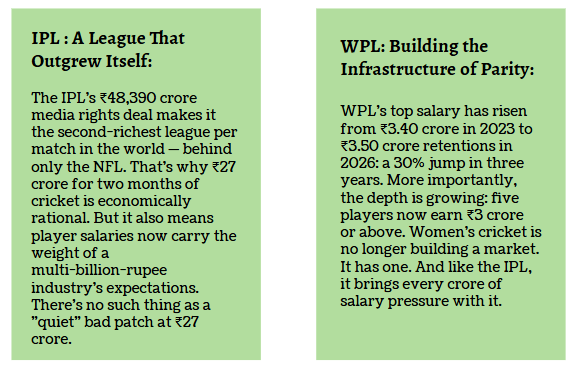
In just three seasons, WPL’s top salary has moved from ₹3.40 crore (2023 auction) to ₹3.50 crore retentions in 2026. The league is building genuine depth in its top earner bracket, not just isolated headline figures.
What does all this money really mean?
The ₹151 crore total salary cap for 2026 is only possible because franchise revenues: from media rights, sponsorships, gate receipts, to merchandise, and digital streaming, have all scaled proportionally.
IPL teams now function as media businesses that play cricket, not cricket teams that happen to generate revenue. That shift explains why the salary cap keeps rising even as the league matures.
When Will WPL Salaries Equal IPL? The Honest Answer.
The gap between Rishabh Pant (₹27 crore) and Smriti Mandhana (₹3.50 crore) is roughly 7.7 to 1. Between Pant and Deepti Sharma (₹3.20 crore), it’s 9 to 1. That’s a number worth sitting with and worth understanding properly.
The IPL’s media rights deal for 2023–27 is ₹48,390 crore. The WPL’s equivalent deal is ₹951 crore, roughly 50 times smaller. Player salaries flow from that revenue base. Until the base changes, the gap persists.
✅ What’s Already Equal
Since October 2022, men’s and women’s cricketers earn the same international match fees: ₹15 lakh per Test, ₹6 lakh per ODI, ₹3 lakh per T20I. In December 2025, the BCCI extended this to domestic cricket too, with women now earning ₹50,000 per day for domestic matches, the same as men. Match fee parity is done. Annual contract parity is not.
People compare WPL 2026 salaries to IPL 2026 salaries and call it a gap. The more honest comparison is WPL Year 4 vs IPL Year 4. In 2011 (IPL’s 4th season), the top auction price was around ₹14–15 crore. WPL’s equivalent at Year 4 is ₹3.50 crore: a smaller number, but a league with far better infrastructure, broadcast deals, and institutional support than the IPL had at the same stage. The WPL is building faster than the IPL ever did.
“The WPL is already the second-most valuable women’s sports league in the world. The question isn’t whether salaries will rise. It’s whether the commercial infrastructure will be built fast enough to make parity possible within a decade.”
Complete salary parity, where Mandhana earns what Pant earns is unlikely before 2035 under current growth trajectories, and requires favourable commercial conditions at multiple decision points between now and then.
But meaningful parity where WPL’s top earners make ₹8–12 crore, reducing the ratio to 2:1 or 3:1 is achievable by the early 2030s, if the media rights trajectory holds and BCCI commits to structural investment in the women’s game.
This is not a distant dream. It a realistic 10-year outcome for a league already setting global records in only its fourth season.
The Final Word
The numbers will change. The ceiling will rise. New records will replace old ones.
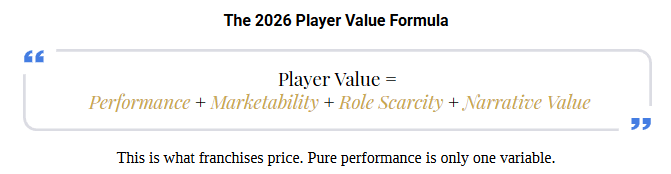
But what 2026 makes clear is this: salaries in cricket are no longer just about how well someone plays. They are about how much a player can carry: expectation, identity, visibility, and belief.
The IPL shows us what a fully built sports economy looks like. The WPL shows us what one becoming looks like. Between them sits not just a gap, but a trajectory.
And maybe that’s the real story:
Not how far apart the numbers are today,
But how quickly they’re moving toward each other.
Because in sport, as in markets, value doesn’t just reflect reality.
It shapes what reality becomes next.
- IPL 2026: Complete Salary Rankings
- WPL 2026: Complete Salary Rankings
- What does all this money really mean?
- When Will WPL Salaries Equal IPL? The Honest Answer.
- The Final Word
- Who is the highest-paid IPL player in 2026?
- Who is the highest-paid WPL player in 2026?
- What is the IPL 2026 overseas salary cap rule?
- Why do so many IPL players earn exactly ₹18 crore in 2026?
- Is the WPL salary gap with IPL closing?
- What is the IPL 2026 total salary cap?
- Does a higher IPL/WPL salary mean a player performs better?