How Technology in IPL Is Changing Cricket and the Future of Sport
Picture this.
An IPL night. The game on the edge.
The ball flies toward the boundary, and in a split second, Phil Salt, representing RCB leaps and pulls off a one-handed screamer against Sunrisers Hyderabad.
For a fan in the stadium, it’s electric.
For someone watching miles away, the question is immediate:
Was that really a catch… or did it just clear the rope?

Photo Credit – https://www.espncricinfo.com/cricketers/phil-salt-669365/photos
The crowd reacts. The replay rolls in.
And within seconds, the answer is clear.
Not because of instinct, but because of technology.
A decade ago, that moment would have lived in debate. Today, it lasts seconds.
The Shift: How Technology in IPL Replaced Guesswork with Data
“The only clue to what man can do is what man has done.”
— R. G. Collingwood
Now imagine that moment without it.
No replays.
No boundary tracking.
No data to confirm what just happened.
Just a moment, and doubt. That used to be cricket. And in many ways, it was beautiful as raw, human, and gloriously imperfect.
But for the 600 million people watching the IPL today, and for franchises built on a combined brand value exceeding ₹90,000 crore, imperfect isn’t good enough anymore.
Today, multiple camera angles, tracking systems, and data analytics capture every movement with precision. What once depended on instinct is now validated instantly.
Over time, we’ve been so immersed in data that it’s no longer an add-on. It’s an essential layer of how we watch, understand, and enjoy the game.
And nowhere is this transformation more visible than in the IPL in India.
Before we talk about where cricket is going, let’s talk about what it was. And deconstruct how it is today.
1. How technology changed the IPL Auction?
In the first auction in 2008 for IPL, the player selections were made on reputation, recent performance, and gut. The result? Franchises overpaid for the past.
A right-arm medium pacer who scared batters on the green, bouncy Durban pitches was purchased for ₹8 crore to play on the slow, turning surfaces of Chennai.
Nobody had run the numbers, because there were no numbers to run.
The contrast with today is incomparable. Data has become a mandatory currency of value.
Modern franchises rely on IPL data analytics, complex player valuation systems that assess:
- Strike rates by match phase
- Match-ups against specific bowlers
- Performance across pitch conditions
- Injury history and workload
- Age-based performance decline
A franchise spending ₹15 crore on an all-rounder today knows, with reasonable precision, what they’re getting, and more importantly, what they’re not.
A ₹15 crore decision is no longer a gamble. It’s a calculated investment.
2. Smart Infrastructure: Built for More Than Cricket
The transformation isn’t limited to the field.
Take the Narendra Modi Stadium, the world’s largest cricket stadium.
But size isn’t its biggest innovation. Intelligence is.
From the moment a fan enters:
- AI systems optimise crowd movement
- IoT sensors manage infrastructure in real time
- 5G networks support thousands of simultaneous users
- Cashless systems eliminate friction
Even the pitch is monitored through sensors that regulate moisture and trigger automated irrigation.
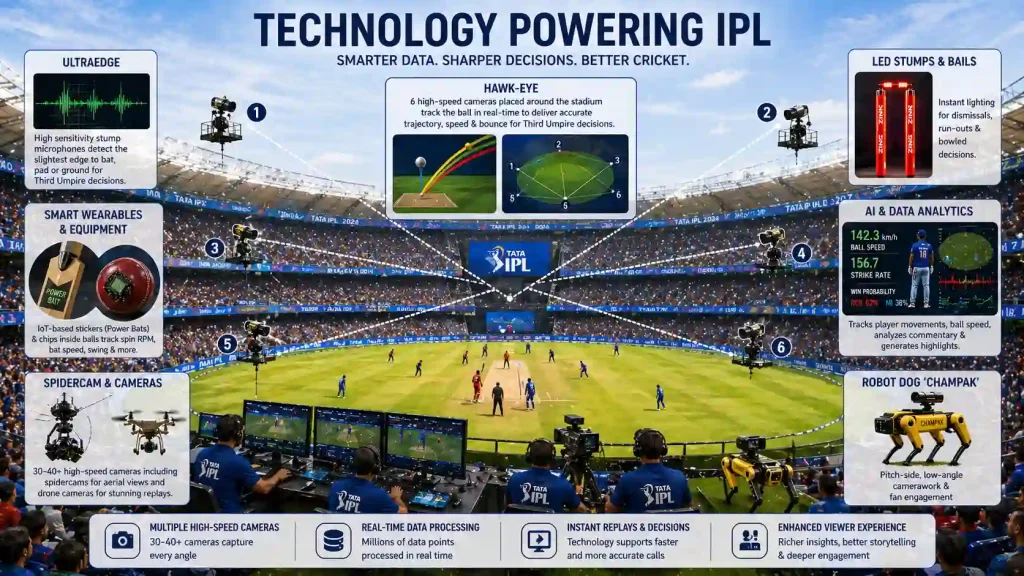
Apart from this, infrastructure-wise, the stadiums are also equipped with other tech such as:
-
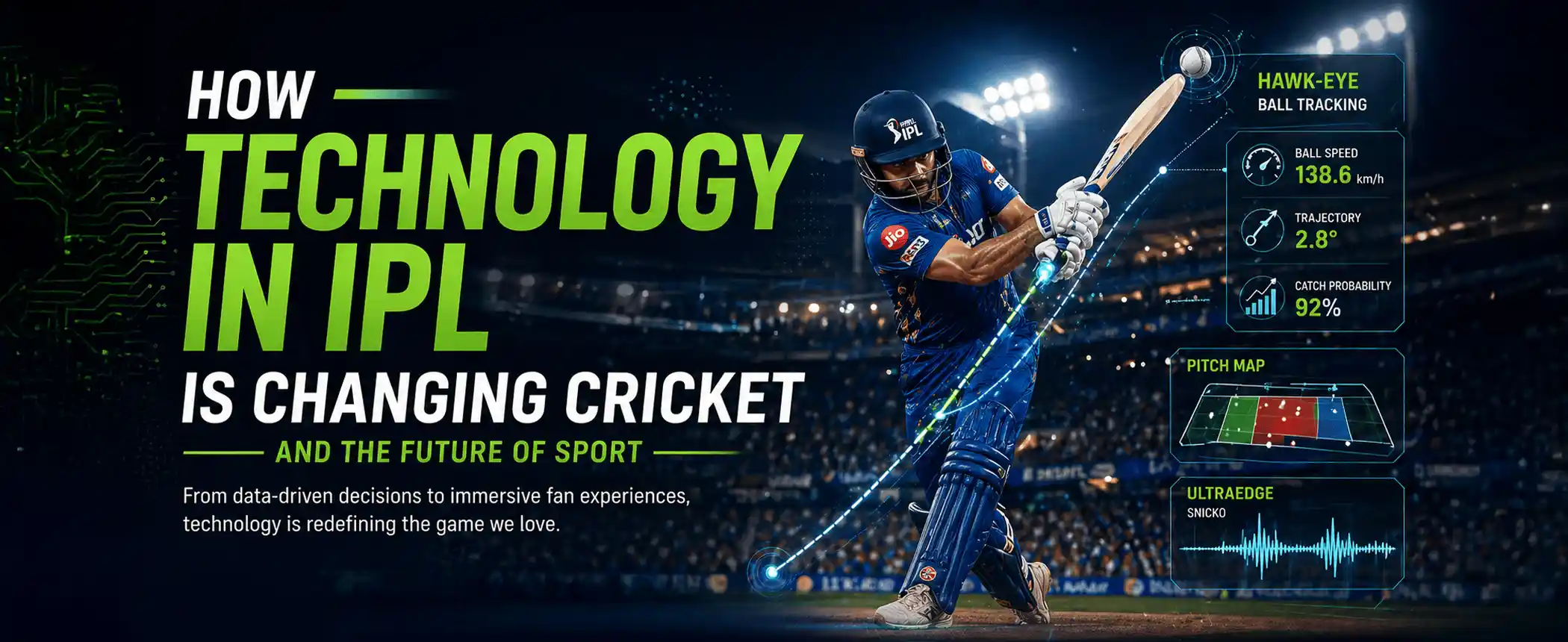
Hawk-Eye: 6 cameras that track ball trajectory, speed, and swing for accurate decisions.
-
UltraEdge: Uses sensitive audio + visuals to detect edges.
-
LED Stumps & Bails: Light up instantly for precise run-out/bowled calls.
-
Spidercam & Cameras: 30–40+ cameras, including aerial and drone views.
-
AI & Data Analytics: Real-time insights on players, performance, and predictions.
-
Smart Wearables: Sensors in bats/balls track bat speed, swing, and spin RPM.
-
Robot Dog (Champak): Low-angle shots + fan engagement tool.
The stadium is no longer just where the game is played. It’s where the data is collected, the fans are monetised, and the next generation of athletes are inspired.
3. Commentary in IPL- Faster and Better
Earlier:
“That looked out…”
Now:
“Based on impact and trajectory, that’s clipping leg, its the umpire’s call.”
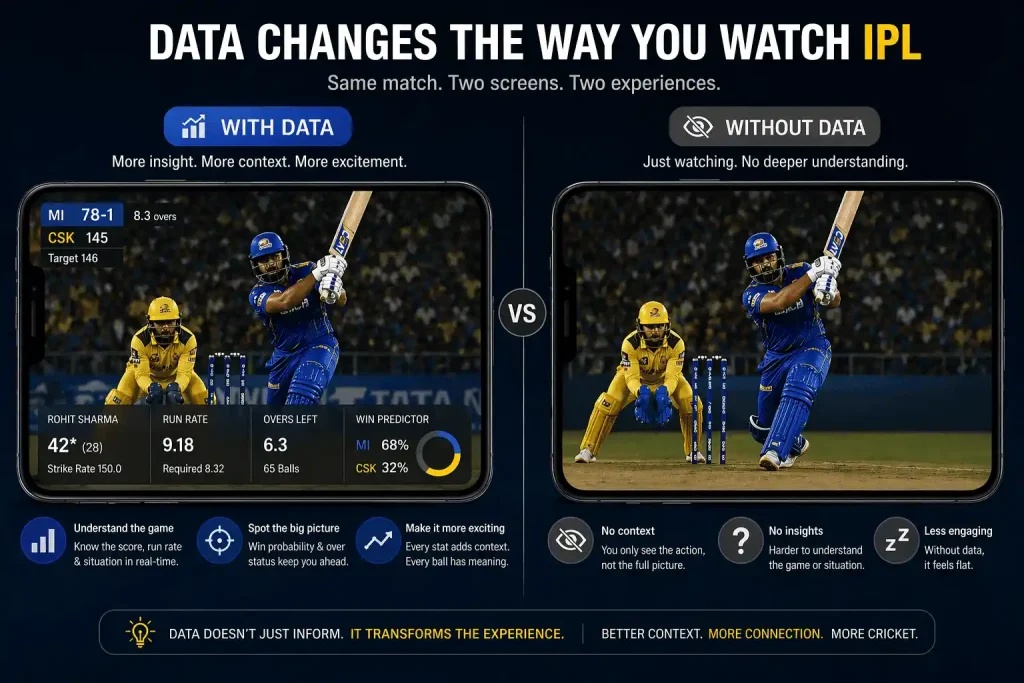
Commentators are using tech to react faster and sound smarter in real time. Every delivery now comes with context of past match-ups, strike rates, predictive probabilities.
This has turned commentary into a blend of storytelling and analysis.
As a result, the modern commentator isn’t just a narrator of moments, but a translator of data, making the game smarter, sharper, and far more immersive for millions watching.
4. Fantasy Sports and Gaming
Here’s a number that should stop you: India has over 150 million fantasy sports users. During IPL 2023, more than ₹2,500 crore was transacted across fantasy platforms in a single season.
This shift is not trivial. It created a generation of fans who are statistically literate about cricket in a way no previous generation was.
It raised a fascinating legal question. In 2021, the Punjab and Haryana High Court ruled that fantasy cricket constitutes a “game of skill”, not just gambling. The ruling validated a new form of sports engagement.
For new age fans, the crossover goes further still.
Cricket-themed mobile games, esports tournaments built around IPL franchises, and digital collectibles are blurring the boundary between watching a sport and playing one.
5. Wearables and Injury Prevention : Longer Athlete Careers
Here’s the story that rarely gets told about pre-analytics cricket: the careers quietly ended by overuse.
A fast bowler, 24 years old, in the form of his life, bowled in 18 of 14 consecutive matches across formats. His lower back had been sending warning signals for three weeks.
The physio noticed. But the team needed him, and there was no system in place to check the load he would be carrying. So he bowled. And then he didn’t bowl for eighteen months.
Cricket produced brilliant short careers that didn’t need to be short.
Wearable technology and biomechanical monitoring changed this permanently. GPS vests track distance covered and acceleration forces. Heart rate variability measures recovery quality.
Bowling-load algorithms, used by every IPL franchise quantify exactly how many overs a fast bowler can safely deliver in a week, a month, a season. When the threshold is approached, the system flags it. The player rests. The career continues.
Workload management is now estimated to have extended the peak playing years of fast bowlers by two to three seasons on average. Yay technology!
6. Data Didn’t Kill the Thrill. It Saved It
The biggest fear of data analytics entering cricket was the loss of its magic and thrill. That the game would become a spreadsheet sport – cold, calculated, and predictable.
The opposite happened.
When every team started optimising with data, they started optimising against each other’s data.
New bowling variations were developed specifically to defeat analytics-era batting strategies. New fielding formations emerged to counter match-up algorithms.
The race produced the most tactically inventive, strategically layered cricket in the sport’s history.
Data found the hidden talents. It extended the careers fans loved. It filled stadiums with fans who understood the game deeply with complete awareness.
7. India’s Sport Tech Moment
The digital infrastructure, stadium technology, athlete science programs, and fan engagement platforms that IPL developed over 17 seasons are now being adopted and adapted across other multi-sport platforms.
India’s sports technology startup ecosystem crossed $500 million in cumulative funding in 2023. Companies building performance analytics platforms, sports medicine AI, fan engagement tools, and stadium management software are finding their first and most enthusiastic customers in Indian sports franchises.
Government policy is aligned.
-
The Khelo India program has invested in grassroots sports infrastructure across 700+ districts.
-
The NSDF (National Sports Development Fund ) funds elite athlete development.
-
The National Education Policy now includes sports science as a formal academic discipline.
These are not peripheral decisions, they are systematic investments in a sports economy that IPL proved could be world-class.
Cricket didn’t just become more watchable. It became a template.
Where is the future of sports technology heading?
The next phase of sports technology is already taking shape.
As industry leaders such as Rahat Kulshreshtha, Founder of Quidich Innovation Labs suggest, the convergence of:
-
tracking systems
-
AI-driven modelling
-
spatial reconstruction
-
real-time analytics
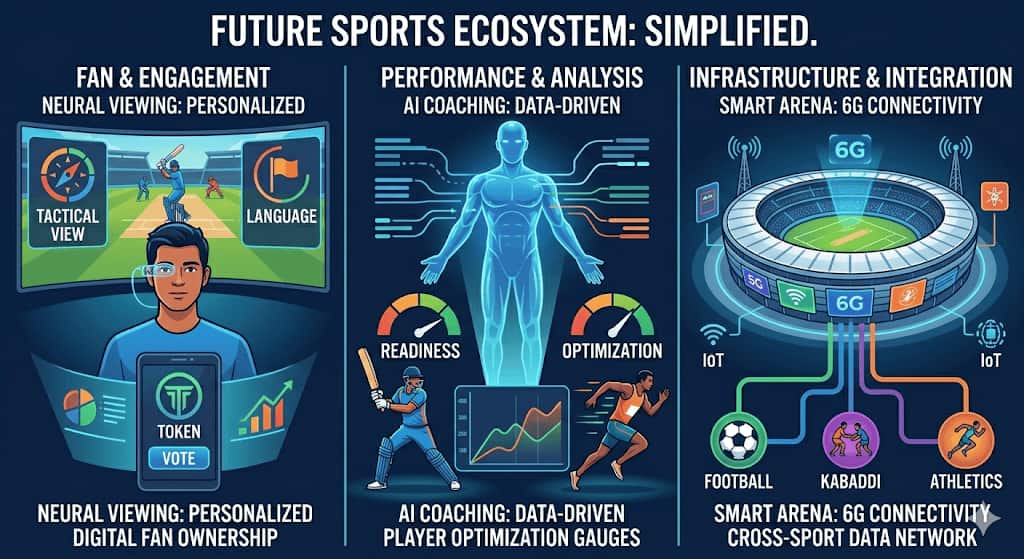
will create a seamless, immersive system. The result?
-
Watching from home will feel like being in the stadium.
-
Real-time insights will replace post-match analysis
-
Fans will interact, react, and experience sport together, virtually
The boundary between the physical and digital stadium will dissolve.
How to secure a future in Sports Technology?
Beneath this seamless experience lies something far more complex.
For every “effortless” moment, there will be layers of human expertise working in sync:
-
Data scientists
-
Broadcast engineers
-
Performance analysts
-
AI specialists
-
Video Editors and designers.
The system may feel singular, but it will be powered by many.
How to become the next sports techie?
The first step begins with a Sports Science Degree with IISM.
The future of sport lies at the intersection of intelligence, immersion, and personalisation, where the game is not just watched, but felt.
When will we see you there? Don’t lose out on the right time to enter!