Rise of WPL: Changing the Fabric of Indian Women’s Cricket
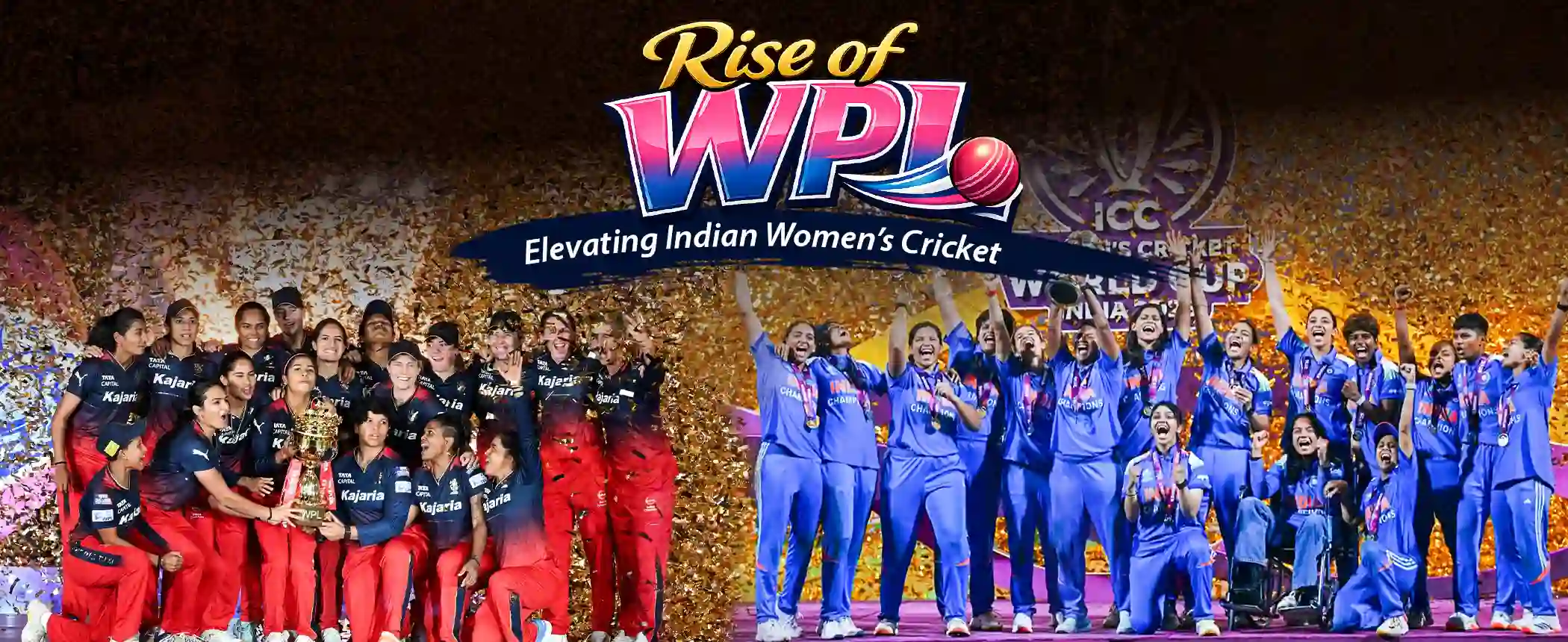
The Women’s Premier League (WPL) is into its 4th season in 2026 and is generating quite the hype, post India’s World Cup victory just a couple of months ago. All the WPL games to be held in Navi Mumbai & Vadodara from January 9th to February 5th are bound to be sold out as India’s women cricketers are set to experience unprecedented stardom.
Apart from Smriti Mandhana & Harmanpreet Kaur — who have been household names since 2017 — youngsters like Jemimah Rodrigues, Deepti Sharma, Richa Ghosh, Shafali Verma and Pratika Rawal have also gained massive popularity of late. However, this wasn’t the case 10-15 years ago!
Women’s cricket had always been on the back burner in India — an afterthought! There used to be a time when players like Mithali Raj and Jhulan Goswami, who are deemed as the GOATs of Indian women’s cricket, had debuted when the Indian Women’s Cricket team barely got any support. Mere thousand rupees as match fees, lack of any proper travel and accommodation, no recognition by audiences and multiple sporting & non-sporting issues that showed a gulf of disparity with the Indian Men’s Cricket team.
Then came the shift in the 2010s when Indian players started making an impact on the global stage. The 2017 Women’s ODI World Cup was the turning point that changed the trajectory of women’s cricket in India and eventually gave birth to the WPL.
The Origins of WPL
2017 ODI World Cup & Women’s T20 Challenge
The likes of Smriti Mandhana and Harmanpreet Kaur led India’s transformation with swashbuckling performances in the 2017 Women’s ODI World Cup. Mandhana particularly stole the spotlight with her match-winning knocks and became a household name. Contracts for international T20 leagues like Big Bash League (Australia), The Hundred (UK) and Caribbean Premier League (West Indies) started to materialize for players like Smriti, Harmanpreet, and Jemimah.
However, there was a sentiment about why a Women’s IPL doesn’t exist. And just a year later, the BCCI held a one-off exhibition game during the Men’s IPL playoffs in May 2018, which got decent response. Even international players like Ellyse Perry, Alyssa Healy, Megan Schutt and Meg Lanning vouched for having a Women’s IPL after playing in the highly-competitive one-off game at the Wankhede stadium.
This Women’s T20 challenge got expanded to a tri-series competition in 2019 and was held for two more years in 2020 and 2022 with more Indian and international players getting the chance to play. And then came the moment of reckoning when the BCCI chiefs green-lit the idea of the Women’s Premier League for the 2023 season.
WPL: Teams, Auction, Format
WPL Teams
The bidding process for WPL franchises in late 2022 and early 2023 with BCCI inviting existing IPL franchise owners as well to bid for new WPL teams. 7 of the 10 franchise owners entered the auction besides other parties. Total five teams were to be sold, so it was expected that each of existing IPL team brands will also have subsidiary WPL teams.
However, only Royal Challengers Bengaluru (RCB), Mumbai Indians (MI), and Delhi Capitals (DC) were successful in bidding to secure a franchise. Meanwhile, the owners of Kolkata Knight Riders, Punjab Kings, Rajasthan Royals and Sunrisers Hyderabad were unsuccessful with their bids. The remaining two franchises were snapped up by Capri Global from Lucknow and the Adani Group based in Ahmedabad to form two new teams namely, UP Warriorz (UPW) and Gujarat Giants (GG) respectively.
The collective bid amount of all five franchises went up to ₹4670 crores, in which the Adani Group paid the highest sum of ₹1289 crores for the Gujarat franchise. Meanwhile, each of the four other franchises were sold for under ₹1000 crores: Mumbai Indians (₹913 crores), Royal Challengers Bengaluru (₹901 crores), Delhi Capitals (₹810 crores), UP Warriorz (₹757 crores).
For a new sporting property like the WPL, that too, in Indian women’s cricket, where sponsors and business groups had always hesitated with regards to investments, these exorbitant winning bids were a massive breakthrough.
Also Read: World’s Top 10 Richest Sports Leagues: The Billion Dollar Powerhouses
WPL Auction
The IPL’s player auction was also adopted by the WPL, with even star players like Smriti Mandhana and Harmanpreet Kaur going under the hammer. In the first auction in 2022-23, all teams had an auction purse of ₹12 crores, which was increased by ₹1.5 crore in subsequent years. The latest auction purse in the WPL stands at ₹15 crores.
As for the auction that was held ahead of the 2026 WPL, many Indian stars got hefty paychecks in the aftermath of India’s historic World Cup victory in November 2025. Deepti Sharma was the pick of the auction, bought by the UP Warriorz for ₹3.2 crores. Even some of overseas players went for big sums namely, Amelia Kerr (₹3 crores), Sophie Devine (₹2 crores), Meg Lanning (₹1.9 crores).
Smriti Mandhana, though, remains the highest-paid player in the WPL, having been bought by RCB for ₹3.4 crores in 2023, and has been retained for ₹3.5 crores in the past two seasons. Ashleigh Gardner and Nat Sciver-Brunt matched Smriti’s paycheck of ₹3.5 crores in this year’s retention, having been bought by Gujarat and Mumbai respectively for ₹3.2 crores.
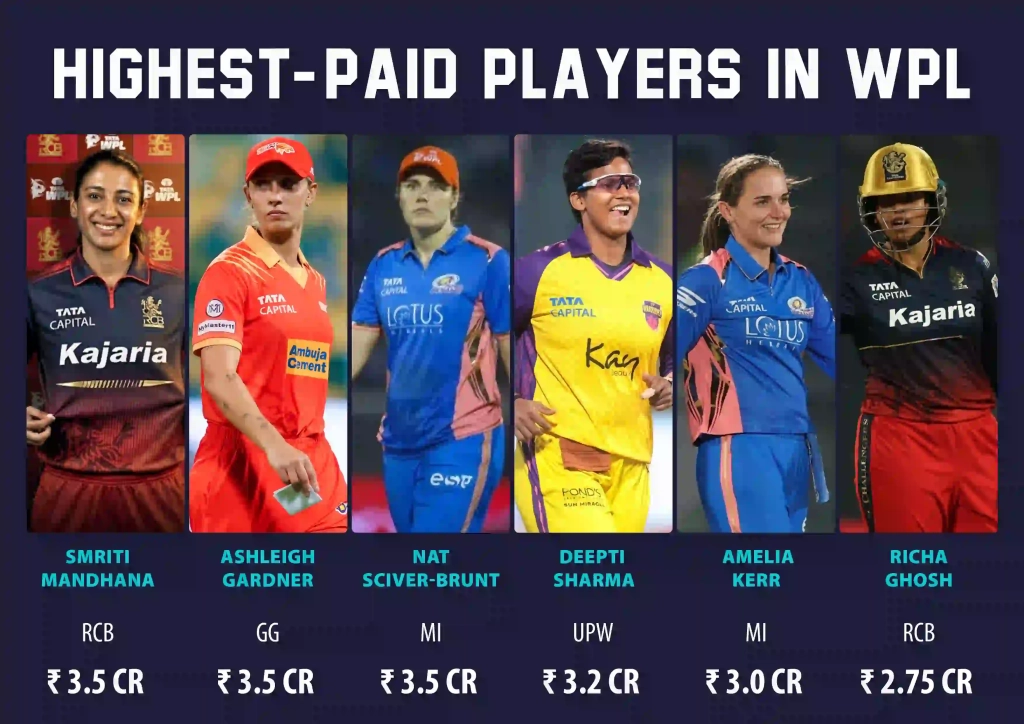
Highest-Paid Players in WPL
WPL Format
With just five teams, the WPL opted for a simple double round-robin format, wherein each team plays the other four teams twice. Similar to the IPL, they also adopted the play-offs format, with one key change: the table-topping team will directly qualify for the final, while the the second & third-placed teams will compete in the eliminator to become the second finalist.
As for the home-away format of the games, though, as in the IPL; the WPL hasn’t yet scaled to that level to host games across five different home venues of the five teams. In the inaugural WPL edition in 2023, all the matches were held in the Brabourne Stadium in Mumbai and the DY Patil Stadium in Navi Mumbai. The 2024 edition, meanwhile, was held at the M Chinaswamy Stadium in Bengaluru and the Arun Jaitley Stadium in Delhi.
2025 was the first time when the WPL was held at more than two different venues in Bengaluru, Mumbai and two more venues at the Ekana Stadium in Lucknow and the BCA Stadium in Vadodara. This was as close as it came to the home-away format in the WPL. In 2026, though, the WPL is once again happening in two legs in two cities: Navi Mumbai and Vadodara. And there’s good reason for the same.
WPL Dates & Season Window
The WPL has been scheduled to take place in the February-March window, ideally concluding by the end of February to give a good breather to pitches before the two-month mayhem of the IPL kicks off. However, the 2026 WPL is scheduled to happen in January-February — from 9th January to 5th February.
A major reason behind this advancement is the Men’s T20 World Cup happening in February-March, co-hosted by India and Sri Lanka. This is also a reason as to why the WPL has been contained to two venues in Navi Mumbai and Vadodara, which won’t be hosting any of the Men’s T20 World Cup games.
Impact of WPL on Indian Women’s Cricket
Better Player Pool, Exposure to Pressure Games
The WPL’s core aim was always to give opportunities to younger female cricketers and help them establish their name on the national stage. Naturally, how the IPL groomed a whole generation of youngsters like Hardik Pandya, Jasprit Bumrah, Shreyas Iyer, and Rishabh Pant to perform on the big stage, the WPL also got its own pool of trailblazers.
The likes of Shafali Verma, Richa Ghosh, Shreyanka Patil, Titas Sadhu, Asha Sobhana, Saima Thakor and several other players have attained national team call-ups through the years via the WT20 Challenge and the initial three editions of the WPL. And the kind of quality performances, these players have showcased under pressure situations for their respective franchises and Team India underscores the impact of the WPL.
Playing in high-pressure games in the play-offs, defending low scores, chasing high totals and rubbing shoulders with international stars like Ellyse Perry, Sophie Ecclestone, Amelia Kerr and much more. India’s women cricketers have experienced a massive shift in their development as players and its effects are visible on and off the field.
Financial Impact: Better Salaries, Endorsements
Apart from the highest-paid players mentioned above, several other Indian young players have got excellent salaries from their respective franchises. Richa Ghosh is the prime example of the same, having been retained by RCB for ₹2.75 crores. Meanwhile, Jemimah Rodrigues and Shafali Verma have also secured lucrative contracts for ₹2.2 crores per season from the Delhi Capitals.
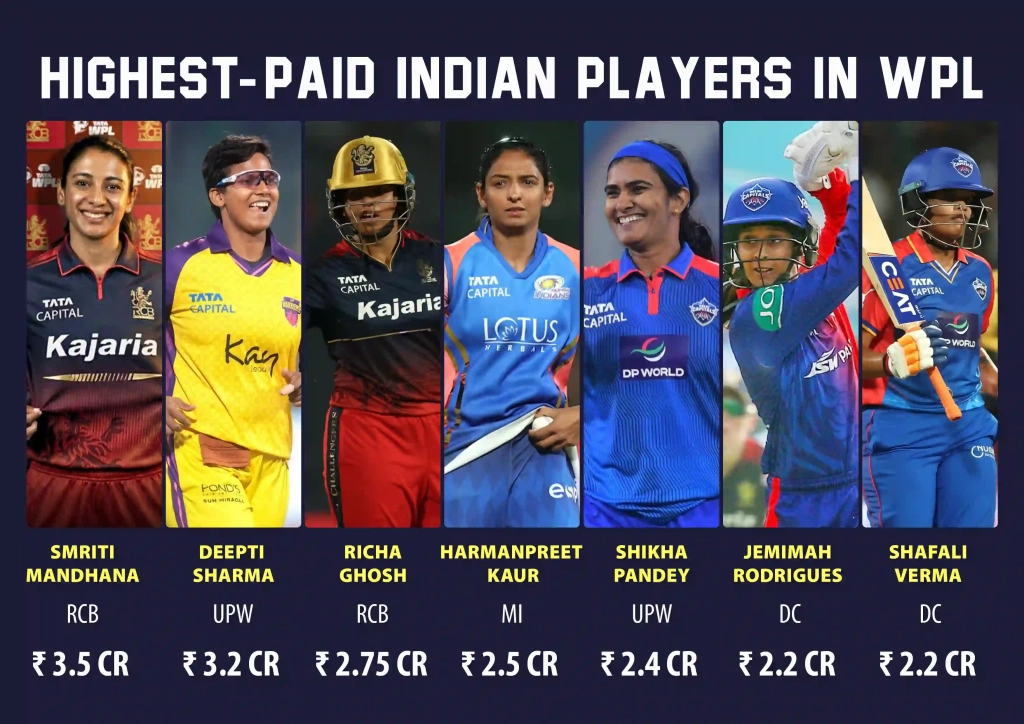
Highest-Paid Indian Players in WPL
Even young upcoming players like Sree Charani, Kranti Gaud, Pratika Rawal have found takers in the WPL at decent prices of nearly a crore along with their now-experienced peers like Radha Yadav, Shreyanka Patil, Renuka Singh Thakur, Arundhati Reddy, Pooja Vastrakar also retaining good earnings.
The larger impact has been the increase in match fee structure and annual contract salaries for the Indian national players. While 15-20 years ago, women cricketers got salaries in mere thousands, the current salary structure ensures some sort of financial stability for India’s female cricketers.
BCCI’s Annual Central Contracts
-
Grade A Players: ₹50 Lakhs
-
Grade B Players: ₹30 Lakhs
-
Grade C Players: ₹10 Lakhs
Match Fee Structure [Same for India Women & Men]
-
Test Match: ₹15 Lakhs per match
-
ODI: ₹6 Lakhs per match
-
T20I: ₹3 Lakhs per match
Apart from this, the number of endorsement deals and featured interviews have also skyrocketed for Indian women cricketers. Smriti Mandhana’s star value has clearly been the highest, with brands like Hyundai, State Bank of India (SBI), Nike and many more signing her for their endorsement campaigns.
Smriti is also a Red Bull athlete, which makes her one of their ambassadors, with Nike also signing a similar deal four years ago. Besides that, Mastercard, Gulf Oil, PNB MetLife, Wrangler and many other brands are endorsed by the Indian opener.
Jemimah Rodrigues is another player who has shot to fame after her magnificent performance in India’s victorious 2025 World Cup campaign. She has endorsed brands like Boat, KFC, and Hyundai. And just like her peer Smriti, Jemimah has signed a long-term association with Red Bull.
Besides these endorsements, magazine cover features and podcast interviews have been a regular occurrence for these female stars of Indian cricket. Man’s World, Vogue and similar magazines have featured players like Jemimah, Shafali Verma, Harmanpreet Kaur, Pratika Rawal and Deepti Sharma on the cover pages lately post the World Cup triumph. And the WPL has played a major role in this success with initial foundation of this fame laid via the league’s commercial success.
Rising Audience: TV, Digital, Stadium Crowds
There was a time women’s games barely got audiences, both on TV and in the stadium. Tickets used to be free, even for the international matches played by India. BCCI often urged people to flock to the stadium to get some audience. Cut to the post-WPL era, its a completely different picture.
The 2017 World Cup did a lot for Indian women’s cricket, pushing players like Smriti and Harmanpreet into the spotlight. However, the real boost came post-COVID with the Women’s Premier League capitalizing on this existing momentum as the M Chinaswamy stadium in Bengaluru saw packed crowds hooting and cheering for almost all of the WPL games it hosted.
And from free tickets, women’s cricket games started getting decent pricing. The excitement of watching Smriti play for RCB, Harmanpreet play for MI, Jemimah play for DC stuck with people, as was the case with the IPL in its initial days. The tickets for the 2026 edition of the WPL matches have been given a modest pricing, though, starting in the ₹100 to ₹200 range.
With the 2025 Women’s World Cup ticket pricing also in the same range, BCCI is expecting a similar turnout and is keen to further promote women’s cricket games to have a full house of enthusiastic crowds. And naturally, this has also affected the TV and digital viewership as well.
Dive deep into how the IPL became a sporting and commercial phenomenon in our blog titled How IPL Led India’s Billion-Dollar Sports Revolution
Media Rights Value & Sponsorships on the up
The media rights for the WPL were sold for ₹951 crores in 2023 to Viacom18 (now JioStar), which highlighted that stakeholders knew this was going to be a significant sporting property. And audiences haven’t disappointed, as viewership figures have increased beyond anyone’s expectations.
Over 3 crore people watched the opening game of the 2025 WPL on TV, while the overall digital viewership also saw a 70% increase, per Exchange4Media. As of the 2025 season, the WPL reportedly has a reach of 30 crores across TV and digital, which is a crucial boost for its commercial value on the sponsorships front.
Last year, the league sponsorships reportedly generated over ₹50 crores, with additional ₹50-65 crores coming via team sponsorships. Ahead of the 2026 season, the WPL has onboarded three more sponsors namely, ChatGPT, Kingfisher, and Bisleri, who have a collective deal value of reportedly ₹48 crores, for the period of 2026-27.
On-field Impact: India’s World Cup Triumph
An uncanny resemblance between the IPL and WPL: India won the ICC ODI World Cup (2011 & 2025), after three seasons of the IPL (2008-10) and the WPL (2023-25) respectively! And as mentioned above, the improved quality of players and better on-field experience in terms of handling pressure in the IPL & the WPL were pivotal factors to these World Cup triumphs.
In Indian women’s cricket particularly, though, the boost to its player pool has been the WPL’s biggest contribution. The number of players who debuted for India during the period of 2022 to 2025 shows the riches of India’s domestic cricket and how the WPL gave them a platform to showcase their talent.
Youngsters like Sree Charani and Kranti Gaud were lucky enough to showcase their talent and directly secure a place in India’s World Cup-winning squad after playing just a few games in 2025. Meanwhile, players like Amanjot Kaur and Pratika Rawal had been showcasing their skills in the domestic circuit for quite some time and got their deserved national call-ups to play crucial roles in India’s historic triumph.
Conclusion
The WPL hasn’t just been another league — it’s a revolution of Indian women’s cricket that has capitalized on the growing interest in the country. While players like Smriti Mandhana, Jemimah Rodrigues, Harmanpreet Kaur, and Deepti Sharma are becoming icons, many young girls are taking inspiration to pick up the bat and ball and dream of becoming a cricketer — which was rare a decade or two ago.
And this naturally also shows in the increased audiences at women’s cricket games, be it in the WPL or India’s international matches. The team and media rights valuations which are at roughly ₹1000 crores are bound to grow further just like it did for the IPL. Broadcasters, advertisers and sponsors will want to invest in the WPL, as more the eyeballs watching women’s cricket, they don’t need to worry about the ROI.
10-15 years down the line, if Indian women’s cricket equals the kind of popularity and commercial success men’s cricket experiences at the moment, a major chunk of the credit will definitely go to the WPL!